|
|
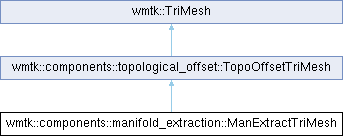
| ManExtractTriMesh (Parameters &_m_man_params, topological_offset::Parameters &_m_top_params, int _num_threads=0) |
| |
|
size_t | label_non_manifold () |
| | label nonmanifold simplices (edges and verts). Corresponding attributes have label set to 1
|
| |
|
bool | vertex_is_manifold (const Tuple &v) const |
| | check if a vertex is manifold. A vertex is manifold if all 'inside' and all 'outside' tets adjacent to the vertex form single face-reachable connected components, respectively. For vertices on the boundary of the mesh, external space is considered an 'outside' polyhedra that is face connected to all tets on the mesh boundary.
|
| |
|
void | vertex_dfs_helper (std::set< size_t > &visited_fids, const Tuple &f) const |
| | dfs helper for vertex manifold check
|
| |
|
void | extract_curve_mesh (MatrixXd &V, MatrixXi &F) const |
| | extract edge mesh separating 'inside' faces from 'outside' faces. Resulting curve is guaranteed to be manifold.
|
| |
|
void | write_curve (const std::string &path) |
| | write curve .obj (boundary of in_tag)
|
| |
| void | classify_curve_edges () |
| | Mark the mesh edges that lie on the input's curve group (EdgeExtra2d::on_curve).
|
| |
|
void | init_region_potentials (double delta, double effective_factor) |
| |
| void | assign_band_regions (bool log=true) |
| |
|
void | log_front_profile (size_t vid) |
| | Diagnostic: the front objective of one vertex along its normal, offset term vs total.
|
| |
|
int | vertex_region (const size_t vid) const |
| |
|
int | edge_region (const size_t va, const size_t vb) const |
| |
|
const OffsetPotential2D & | potential_for_region (const int region) const |
| |
|
const OffsetPotential2D & | potential_for (const size_t vid) const |
| |
| std::shared_ptr< const OffsetPotential2D > | potential_ptr_for (const size_t vid) const |
| |
|
const OffsetPotential2D & | potential_for_edge (const size_t va, const size_t vb) const |
| |
|
const OffsetPotential2D & | potential_for_face (const size_t fid) const |
| |
| std::shared_ptr< SampleEnvelope > | containment_for (uint64_t region_mask, bool on_offset) const |
| | The containment a simplex with this region mask, on/off the offset front, must satisfy – the intersection of everything that holds it, or null if nothing does.
|
| |
| bool | project_into_containment (size_t vid, Vector2d &x) const |
| | Move x back inside every region tube this vertex lies on. True if it ended up inside all of them.
|
| |
| int64_t | tangent_curve_tag (size_t vid, const Vector2d &x) const |
| | Which tag's boundary curve a vertex slides along, or -1.
|
| |
| bool | walk_along_curve (int64_t tag, const Vector2d &x, double s, Vector2d &out) const |
| | March s of arclength along tag tag's boundary polyline from x's foot on it.
|
| |
| bool | curve_tangent (int64_t tag, const Vector2d &x, const Vector2d &prefer, Vector2d &tau) const |
| | The unit tangent of tag tag's curve at x's foot, or false if there is none.
|
| |
| bool | phase_places_front () const |
| |
|
EnvelopeSetup | envelope_setup () const |
| |
|
std::string | envelope_key_name (int64_t tag) const |
| | The name a tag or pseudo-tag prints under.
|
| |
| bool | edge_is_complex_boundary (const Tuple &e) const |
| |
| void | build_boundary_envelopes (const char *when, EnvelopeSetup setup) |
| |
| void | rebuild_offset_envelope () |
| |
| void | check_no_vertex_on_both_surfaces (const char *when) const |
| |
|
void | optimize_offset_single_phase () |
| | TriWild's loop, the front placed inside its smoothing passes.
|
| |
| double | phase_b_front_gradient_linf () |
| |
|
| TopoOffsetTriMesh (Parameters &_m_offset_params, int _num_threads=0) |
| |
| void | set_vertex_position (const size_t vid, const Vector2d &p) |
| | Place a vertex, keeping its exact and rounded coordinates in step.
|
| |
| bool | edge_is_offset (const size_t eid) const |
| |
| bool | edge_is_region (const size_t eid) const |
| |
|
EdgeSnapshot2d | edge_snapshot (const size_t eid) const |
| |
|
void | restore_edge (const size_t eid, const EdgeSnapshot2d &s) |
| |
|
FaceSnapshot2d | face_snapshot (const size_t fid) const |
| |
|
void | restore_face (const size_t fid, const FaceSnapshot2d &s) |
| |
| void | label_offset_boundary () |
| | Tag the two tracked surfaces for the optimization phase.
|
| |
| bool | face_in_region (const size_t fid) const |
| | Whether face fid belongs to the closed offset region, read from its label.
|
| |
| bool | face_is_input_complex (const size_t fid) const |
| |
| bool | vertex_is_on_surface (const size_t vid) const override |
| | The substructure the link condition is evaluated against, derived not cached.
|
| |
| bool | edge_is_on_surface (const std::array< size_t, 2 > &vids) const override |
| | Is an edge part of the substructure.
|
| |
|
void | optimize_offset (const std::filesystem::path &output_file) |
| | The 2D optimization phase: split / collapse / swap / smooth on the shared driver.
|
| |
| bool | face_is_offset_band (const size_t fid) const |
| |
| std::pair< double, double > | compute_distance_deviation () const |
| | How far the offset boundary is from where it should be: {max, avg} over vertices.
|
| |
|
void | log_worst_dist_vertex () const |
| |
| bool | edge_is_offset_surface_live (const Tuple &e) const |
| |
| void | write_debug_pvd () const |
| |
|
bool | marching_split_edge_before (const Tuple &t) |
| |
|
bool | marching_split_edge_after (const Tuple &t) |
| |
|
bool | edge_split_sphere_trace (const Vector2d &p_in, const Vector2d &p_out, Vector2d &p_new, size_t &steps) const |
| | Construction placement under sphere_trace_initialization: sphere tracing along the edge from p_in (the endpoint in the input complex, label != 0) towards p_out (the background endpoint) for the point where d(x) = target_distance, d(x) the distance to the input complex through m_input_complex_bvh. From t = 0 the trace evaluates d at the current point and steps forward by target_distance - d, the largest step that cannot cross the level set (d is 1-Lipschitz); it stops when |d - target_distance| <= sphere_trace_target_rel_tol x target_distance and returns true with p_new there. It returns false, p_new untouched, as soon as the current point reaches or passes p_out (t >= L: the level set is not on the edge) or would move behind p_in (d(p_in) already beyond the target); the caller then places the plain midpoint. Every step taken is longer than the tolerance, so the trace ends within L / (tol x target_distance) steps; steps returns how many it took. No snapping away from the endpoints: a point found arbitrarily close to p_out is used as is. Same as 3D.
|
| |
| bool | collapse_edge_before (const Tuple &t) override |
| | Reject any collapse that violates the substructure link condition.
|
| |
| bool | swap_edge_before (const Tuple &t) override |
| | Reject a flip whose new edge already exists.
|
| |
| bool | swap_edge_after (const Tuple &t) override |
| |
| bool | collapse_before_vertex (size_t v1, size_t v2) override |
| |
| void | collapse_after_vertex (size_t v1, size_t v2) override |
| |
| void | split_after_vertex (size_t v_new) override |
| |
| bool | split_adjust_position (size_t v_new, const std::vector< Tuple > &children) override |
| | Carry each parent's region label onto the two children it became.
|
| |
| bool | smooth_before (const Tuple &t) override |
| | User specified preparations and desideratas for an edge smooth.
|
| |
| bool | smooth_after (const Tuple &t) override |
| | User specified modifications and desideras after an edge smooth.
|
| |
| bool | vertex_is_on_domain_boundary (const size_t vid) const |
| | Identification only – no operation refuses the domain wall through these.
|
| |
|
bool | edge_is_on_domain_boundary (const size_t eid) const |
| |
| void | init_surfaces_and_boundaries () |
| | Classify every region boundary, build the per-tag containment envelopes, and tag the domain wall – once, from the input mesh, before offset construction runs.
|
| |
| void | mark_input_complex_vertices () |
| |
| void | warn_if_offset_reaches_domain_boundary () const |
| | Warn if the offset band has grown into the domain boundary.
|
| |
|
double | ring_max_quality (size_t vid) const |
| | Max AMIPS over the faces incident to vid. -1 if it has none.
|
| |
| double | face_flatness (size_t fid) const |
| | Scale-invariant flatness: 2*area / longest_edge^2.
|
| |
| void | needle_forensics () const |
| | The full post-mortem on why nothing removes the flat faces.
|
| |
|
void | record_flatness (const char *op, double parent_flat, size_t child_fid) const |
| | Genesis: flatness transitions recorded at the operation hooks. {op, parent, child}.
|
| |
| double | offset_edge_sag (size_t a, size_t b) const |
| |
| double | max_offset_edge_sag (const std::vector< std::array< size_t, 2 > > &edges) const |
| |
| bool | ops_guard_refuses_collapse (size_t v1, size_t v2) const |
| |
| std::vector< Tuple > | offset_surface_edges_live_at (size_t vid) const |
| |
| std::vector< char > | offset_surface_foldover_labels () const |
| | Per-vertex 0/1: has the offset curve folded back on itself at this vertex? Debug frame diagnostic; see write_vtu(). Costs one pass over the live offset edges, no field evaluation.
|
| |
|
void | log_smooth_trace () const |
| |
| void | log_region_edge_mask_health (const std::string &when) const |
| | Are the tracked region boundaries actually contained by anything?
|
| |
| void | audit_surface_containment (const std::string &when) const |
| | Which tracked edges are outside their envelope, and by how much.
|
| |
| bool | vertex_is_on_region (const size_t vid) const |
| | Is this vertex on a region boundary – a tag boundary, or the domain wall.
|
| |
| uint64_t | tag_bits (const CellTag &tags) const |
| |
| uint64_t | vertex_boundary_mask (const size_t vid) const |
| | The tag boundaries this vertex lies on – the raw mask gated on the vertex still being region geometry at all.
|
| |
| uint64_t | edge_mask (const std::array< size_t, 2 > &vids) const |
| |
| uint64_t | edge_boundary_bits (const Tuple &e) const |
| | Diagnostic only: which tag boundaries the incident faces say this edge lies on right now – the same symmetric difference init_surfaces_and_boundaries() classified by.
|
| |
| std::shared_ptr< SampleEnvelope > | envelope_for_mask (uint64_t mask) const |
| | The envelope a simplex with this boundary mask is contained in, or null.
|
| |
| std::shared_ptr< SampleEnvelope > | surface_envelope_for_edge (const std::array< size_t, 2 > &vids) const override |
| | Class-0 segments – every region boundary, the input complex and the domain wall included – carry a containment requirement; the offset boundary does not.
|
| |
| bool | smoothing_position_is_allowed (const size_t, const Vector2d &) const override |
| | No per-vertex positional constraint. The per-tag envelopes close that hole structurally – the same deletion 3D made to its lower-strata point refusal.
|
| |
| std::shared_ptr< SampleEnvelope > | smoothing_energy_envelope (const size_t vid) const override |
| | The offset boundary is the one tracked surface with no envelope, in either role.
|
| |
| std::shared_ptr< SampleEnvelope > | smoothing_containment_envelope (const size_t vid) const override |
| | ... and it is not contained by one either, except in Phase A.
|
| |
| bool | smooth_front_vertex_phase_b (const Tuple &t) |
| | Phase B placement of a front vertex: the shared smoother with the offset's options.
|
| |
| double | front_vertex_normal_gradient (size_t vid) const |
| |
| Vector2d | front_vertex_move_direction (size_t vid) const |
| |
| double | front_move_alignment (size_t vid) const |
| |
| bool | front_vertex_alignment_traps_1d_solve (size_t vid) const |
| |
| double | front_vertex_conv_ratio (size_t vid) const |
| |
| bool | front_vertex_placed (size_t vid) const |
| | THE definition of "placed" for a vertex on the offset surface.
|
| |
| bool | front_placed_by_ratio (const double ratio) const |
| |
|
double | edge_conv_ratio (const Tuple &e) const |
| | The edge test divided by its bar (1 = bar), per front_conv_criterion; -1 unmeasurable.
|
| |
| double | edge_conv_ratio (size_t a, size_t b) const |
| |
|
Vector2d | front_vertex_normal (size_t vid) const |
| | The field's outward unit direction at front vertex vid (zero where grad Phi vanishes).
|
| |
| std::shared_ptr< polysolve::nonlinear::Problem > | phase_b_front_objective (size_t vid, const Vector2d &x) const |
| |
| std::shared_ptr< polysolve::nonlinear::Problem > | smoothing_extra_energy (const size_t vid) const override |
| |
| std::shared_ptr< SampleEnvelope > | released_envelope () const |
| |
| bool | edge_borders_released_boundary (const Tuple &e) const |
| |
|
bool | face_is_deformable (size_t fid) const |
| | Under deform_others the same set as face_is_plastic(): every face outside the band.
|
| |
|
bool | face_is_plastic (size_t fid) const |
| |
|
void | stamp_plastic_rests () |
| | Stamp rest := current for every plastic face; called before every operation group.
|
| |
| bool | smooth_plastic_vertex (const Tuple &t) |
| |
| bool | face_is_released_band (size_t fid) const |
| |
| void | stamp_rest_face (size_t fid) |
| |
| void | release_deformable_regions () |
| |
| std::shared_ptr< polysolve::nonlinear::Problem > | rest_energy_for_vertex (size_t vid) const |
| |
| std::shared_ptr< polysolve::nonlinear::Problem > | phase_b_front_energy (size_t vid, const std::shared_ptr< const OffsetPotential2D > &pot) const |
| |
| std::tuple< double, double > | optimization_quality_stats () override |
| | The loop's convergence metric, normalized so that 1.0 means "done".
|
| |
| double | optimization_stop_metric () const override |
| | 1.0 in Phase B, where the metric is normalized; the base's stop_energy in Phase A.
|
| |
| int | stencil_order () const |
| |
| double | offset_residual_tolerance () const |
| |
| double | offset_gradient_tolerance () const |
| | The convergence tolerance: the bound on |grad (Phi - c)^2| at a band vertex.
|
| |
| double | gradient_reference () const |
| |
| void | check_offset_within_support (const char *when) const |
| | Stop the run if any reachable band vertex has left the potential's support.
|
| |
|
DistanceSplit | distance_deviation_split () const |
| |
| DistanceSplit | residual_split () const |
| |
| std::vector< bool > | band_vertex_mask () const |
| |
| double | max_band_vertex_distance () const |
| |
| double | band_vertex_distance_error (const size_t vid) const |
| |
| double | band_vertex_residual (const size_t vid) const |
| |
| EdgeSamples | offset_edge_samples (const Tuple &e) const |
| | The Phi residual at stencil_order interior points of band edge e.
|
| |
| template<typename Visit > |
| void | for_each_offset_edge_sample (const Tuple &e, Visit &&visit) const |
| | Visit the same interior sample points offset_edge_samples() measures on.
|
| |
| GradientSplit | gradient_split (bool include_edge_samples=true) const |
| |
|
EnergyCriterion | energy_criterion () |
| |
| double | front_chord_target (size_t va, size_t vb, double len, double sag, double tube) const |
| |
| size_t | refine_front_from_sag (const std::vector< EnergyCriterion::Refinable > &edges) |
| |
| size_t | refine_front_by_halving (const std::vector< EnergyCriterion::Refinable > &edges) |
| |
| void | grade_sizing (double grade, const std::vector< size_t > &seeds) |
| |
| size_t | grade_sizing_by_distance (const std::vector< size_t > &seeds) |
| |
|
SmoothingProgress | smoothing_progress (const std::vector< Vector2d > &before) |
| | Measure a pass: before holds every live vertex's position before it, indexed by vid.
|
| |
| void | smooth_group_to_convergence (const char *group_name) |
| |
|
double | edge_interpolation_residual (const Tuple &e) const |
| | The interpolation residual of front edge e, see EnergyCriterion. -1 when unmeasurable.
|
| |
|
double | edge_interpolation_residual (size_t a, size_t b) const |
| | The same on a vertex pair; the tuple form delegates here. See edge_conv_ratio(a, b).
|
| |
| Vector2d | offset_vertex_normal (const size_t vid) const |
| | The normal at an offset vertex. Every caller that needs one goes through here, so switching the definition is a one-line edit rather than a hunt through the call sites.
|
| |
| void | report_outside_support (const char *when, const DistanceSplit &s) const |
| |
| bool | band_vertex_is_reachable (const size_t vid) const |
| |
| size_t | refine_sizing_around_worst (double max_metric) override |
| | TriWild's stall-driven sizing refinement, verbatim.
|
| |
| void | log_stuck_refine_census (double max_metric, double filter_energy) |
| | Why Phase A is stuck: a census of the faces stuck-refine is about to chase.
|
| |
| void | log_refine_block_census (const std::string &when, double filter_energy) const |
| | For every element above filter_energy, why its edges cannot be split.
|
| |
| bool | collapse_quality_allowed (size_t v1, size_t v2, double q, double ring_max) const override |
| | Instrumentation only: which operation manufactures the MAX_ENERGY needles.
|
| |
| bool | swap_quality_allowed (const double after, const double before, const bool is_surface_flip) const override |
| |
| void | report_needle (const char *op, size_t fid, double parent_q) const |
| | Where the first needles come from – a tripwire, not a census.
|
| |
| void | needle_scan (const char *when) const |
| |
| void | collapse_pass_begin () override |
| |
| bool | optimization_bare_coarsen_passes () const override |
| |
| bool | collapse_edge_after (const Tuple &t) override |
| | A collapse is accepted by the same criterion the smoothing minimises.
|
| |
| double | face_criterion_rel (const size_t fid) const |
| |
| void | write_smoothing_debug_output (const std::string &path) const override |
| | Put the optimization's frames on the run's single debug timeline (see write_debug_frame()), labelled "r<round><phase><pass>_<op>" / "r<round><phase>_end". <pass> counts passes within the current phase and restarts whenever the round or the phase changes, so r1S3 reads as "round 1, single phase, third pass"; the restart is detected here, so no call site has to remember to reset anything. Renaming here rather than at the call sites keeps this out of the shared driver, whose naming is also triwild's and simwild's. Same scheme as 3D.
|
| |
|
void | append_frame_label (size_t idx, const std::string &label) const |
| | One line of <output>_frames.txt; truncates the file on the first frame.
|
| |
|
void | write_debug_frame (const std::string &label) |
| | One frame of the run's single debug timeline: <output>_NNNNN.vtu with the next sequence number, and one "NNNNN<tab>label" line in <output>_frames.txt. Every debug frame the run writes – the input as loaded, the construction stages, and the optimization's own frames through write_smoothing_debug_output() – goes through this sequence, so the numbers are consecutive and the .txt says what each one is. The only debug files outside it are the ones that are not this mesh: <output>_input_complex.vtu and the phi grid.
|
| |
| void | init_from_image (const MatrixXd &V, const MatrixXi &F, const MatrixSi &F_tags, const MatrixXd &V_env, const MatrixXi &F_env, const std::vector< std::string > &tag_names, const std::string &curve_name="") |
| | initialize TriMesh from vertex, face, tag data
|
| |
|
bool | ambient_assert () |
| | ensure ambient tag does not overlap any other tags in mesh.
|
| |
|
void | label_input_complex () |
| | label input complex simplices as per boolean expression (or single body mode)
|
| |
|
bool | empty_input_complex () |
| | check if the input complex is empty. Only valid after calling init_from_image(...). Checks if any vertices (therefore any simplices) are labelled 1, if not returns true
|
| |
| void | init_input_complex_bvh () |
| | Build the input complex's BVH and its smooth offset potential, from one extraction.
|
| |
| void | init_offset_potential () |
| | Build the smooth offset potential from the extraction init_input_complex_bvh() kept.
|
| |
| bool | split_edge_before (const Tuple &t) override |
| | User specified preparations and desideratas for an edge split.
|
| |
| bool | split_edge_after (const Tuple &t) override |
| | User specified modifications and desideratas after an edge split.
|
| |
| bool | split_face_before (const Tuple &t) override |
| | User specified preparations and desideratas for a face split.
|
| |
| bool | split_face_after (const Tuple &t) override |
| | User specified modifications and desideratas after a face split.
|
| |
| bool | invariants (const std::vector< Tuple > &tris) override |
| | User specified invariants that can't be violated.
|
| |
| void | execute_offset (const std::filesystem::path &output_file) |
| |
| void | marching_tris () |
| |
|
bool | is_simplicially_embedded () const |
| | check if the input complex (simplices labelled 1) are simplicially embedded w.r.t. the entire mesh
|
| |
|
bool | tri_is_simp_emb (const Tuple &t) const |
| | check if a triangle satisfies simpicial embedding criteria w.r.t. input complex (simplices labelled 1)
|
| |
|
void | simplicial_embedding () |
| | make mesh a simplicial embedding of the input complex (simplices labelled 1)
|
| |
|
void | set_offset_tri_tags () |
| | update 'tags' data for triangles in the offset region (tris labelled 2) based on the given offset tag values in m_offset_params.offset_tag_value
|
| |
|
bool | offset_is_manifold () |
| | verify that the closed offset region (simplices labelled 1 or 2) form a manifold region. This should be true for any offset. This function is for verification
|
| |
| void | write_phi_grid (const std::string &path, int n) const |
| | Sample the smooth offset potential on a dense grid and write it as <path>_phi.vtu.
|
| |
|
void | write_input_complex (const std::string &path) |
| |
|
void | write_vtu (const std::string &path) |
| |
|
void | write_msh_groups (const std::string &file) |
| |
|
size_t | edge_id_from_simplex (const simplex::Edge &e) const |
| | get global id of edge from simplex::Edge object
|
| |
|
Tuple | get_tuple_from_edge (const simplex::Edge &e) const |
| | get Tuple simplex::Edge object
|
| |
|
std::vector< Tuple > | get_edge_adjacent_faces (const Tuple &f) const |
| | get faces (as Tuples) that are edge-adjacent to the given face (as Tuple)
|
| |
| | TriOptimizerMesh (OptimizerParameters ¶ms) |
| |
|
size_t | get_partition_id (const Tuple &loc) const |
| |
|
void | partition_mesh () |
| |
|
void | partition_mesh_morton () |
| |
|
double | get_length2 (const Tuple &l) const |
| |
| bool | is_inverted (const std::array< size_t, 3 > &vs) const |
| | Orientation check, exact for the coordinates the vertices actually carry.
|
| |
|
bool | is_inverted (const Tuple &loc) const |
| |
|
bool | is_inverted (const size_t fid) const |
| |
|
bool | is_inverted_f (const Tuple &loc) const |
| | Inversion check using only the double positions.
|
| |
|
bool | is_inverted_f (const size_t fid) const |
| |
|
double | get_quality (const std::array< size_t, 3 > &vs) const |
| |
|
double | get_quality (const Tuple &loc) const |
| |
|
double | get_quality (const size_t fid) const |
| |
|
std::tuple< double, double > | get_max_avg_energy () |
| |
| virtual void | update_attributes () |
| | Update the attributes of the mesh after an iteration of operations.
|
| |
|
void | mesh_improvement (int max_its=80) |
| |
|
std::tuple< double, double > | local_operations (const std::array< int, 4 > &ops, bool collapse_limit_length=true) |
| |
|
bool | is_force_split_edge (const size_t v1, const size_t v2) const |
| |
|
void | split_all_edges () |
| |
| bool | split_edge_before (const Tuple &t) override |
| | User specified preparations and desideratas for an edge split.
|
| |
| bool | split_edge_after (const Tuple &loc) override |
| | User specified modifications and desideratas after an edge split.
|
| |
|
void | collapse_all_edges (bool is_limit_length=true) |
| |
| bool | collapse_edge_before (const Tuple &t) override |
| | User specified preparations and desideratas for an edge collapse including the link check as collapse prerequisite.
|
| |
| bool | collapse_edge_after (const Tuple &t) override |
| | User specified modifications and desideratas after an edge collapse.
|
| |
| size_t | coarsen_mesh () |
| | Coarsen the mesh without letting the max energy rise.
|
| |
| bool | coarsen_collapse_edge (const Tuple &e, std::vector< Tuple > &new_tris) |
| | One collapse under the coarsening rules, outside a coarsening pass.
|
| |
| size_t | swap_all_edges () |
| | Run TriWild's quality-improving interior edge-flip pass.
|
| |
|
double | swap_weight (const Tuple &t) const |
| |
| bool | swap_edge_before (const Tuple &t) override |
| | User specified preparations and desideratas for an edge swap including 1.can't swap on boundary edge. 2. when swap edge between v1, v2, there can't exist edges between the two opposite vertices v3, v4.
|
| |
| bool | swap_edge_after (const Tuple &t) override |
| | User specified modifications and desideras after an edge swap.
|
| |
| void | smooth_all_vertices (size_t n_iters=1) |
| | Run TriWild's vertex-smoothing pass.
|
| |
| bool | smooth_before (const Tuple &t) override |
| | User specified preparations and desideratas for an edge smooth.
|
| |
| bool | smooth_after (const Tuple &t) override |
| | User specified modifications and desideras after an edge smooth.
|
| |
|
Vector2d | smoothing_position (size_t vid) const |
| |
|
void | set_smoothing_position (size_t vid, const Vector2d &p) |
| |
|
double | active_quality_threshold () const |
| |
|
virtual std::vector< size_t > | active_vertices () const |
| |
| virtual double | quality_rel (const size_t fid) const |
| | A face's quality relative to the quality it is required to reach; <= 1 means it meets it.
|
| |
| bool | round (const Tuple &v) |
| | Round a vertex position to floating point, if that inverts no incident face.
|
| |
|
bool | is_edge_on_surface (const Tuple &loc) const |
| |
|
bool | is_edge_on_surface (const std::array< size_t, 2 > &vids) const |
| |
|
bool | is_edge_on_bbox (const Tuple &loc) const |
| |
|
bool | is_edge_on_bbox (const std::array< size_t, 2 > &vids) const |
| |
| bool | vertex_is_on_surface (const size_t vid) const override |
| | Is a vertex part of the substructure.
|
| |
| bool | edge_is_on_surface (const std::array< size_t, 2 > &vids) const override |
| | Is an edge part of the substructure.
|
| |
| bool | surface_segment_is_outside (const size_t a, const size_t b) const |
| |
|
std::vector< std::array< size_t, 2 > > | get_edges_by_condition (std::function< bool(const EdgeAttributes &)> cond) const |
| |
| void | gradation_smooth_sizing (double grade, const std::vector< size_t > &seeds) |
| | Monotone (only-decreasing) gradation smoothing of the sizing field.
|
| |
| void | init (size_t n_vertices, const std::vector< std::array< size_t, 3 > > &tris) |
| |
| void | init (const MatrixXi &F) |
| | Generate the connectivity of the mesh from an IGL-style F matrix.
|
| |
| std::vector< Tuple > | get_vertices () const |
| |
| std::vector< Tuple > | get_edges () const |
| |
| std::vector< Tuple > | get_faces () const |
| |
| Tuple | tuple_from_edge (size_t vid1, size_t vid2, size_t fid) const |
| |
|
Tuple | tuple_from_vids (size_t vid0, size_t vid1, size_t vid2) const |
| |
|
simplex::Vertex | simplex_from_vertex (const Tuple &t) const |
| |
|
simplex::Edge | simplex_from_edge (const Tuple &t) const |
| |
|
simplex::Face | simplex_from_face (const Tuple &t) const |
| |
|
simplex::Face | simplex_from_face (const size_t fid) const |
| |
|
Tuple | tuple_from_simplex (const simplex::Face &s) const |
| |
|
simplex::SimplexCollection | simplex_incident_triangles (const simplex::Vertex &v) const |
| |
|
simplex::SimplexCollection | simplex_incident_triangles (const simplex::Edge &e) const |
| |
|
simplex::SimplexCollection | simplex_link_vertices (const simplex::Vertex &v) const |
| |
|
simplex::SimplexCollection | simplex_link_vertices (const simplex::Edge &e) const |
| |
|
simplex::SimplexCollection | simplex_link_edges (const simplex::Vertex &v) const |
| |
|
void | set_preallocation_factor (double factor) |
| | Preallocation factor: init/consolidate reserve capacity = max(floor, ceil(factor * live_count)) so operations can grab fresh slots without resizing the storage. When a pass exhausts the reserved capacity the affected operations fail (retried later after a consolidate). Values < 1 are clamped to 1.
|
| |
|
double | preallocation_factor () const |
| |
|
bool | slots_exhausted () const |
| |
|
void | clear_slots_exhausted () |
| |
|
size_t | request_tri_slots (size_t n) |
| |
|
size_t | request_vert_slots (size_t n) |
| |
| size_t | tri_capacity () const |
| | get the current largest global fid
|
| |
| size_t | vert_capacity () const |
| | get the current largest global vid
|
| |
| void | consolidate_mesh () |
| | removing the elements that are removed
|
| |
| void | remove_tris_by_ids (const std::vector< size_t > &fids) |
| | Mark the given triangles, and any vertex left without an incident triangle, as removed.
|
| |
|
Tuple | switch_vertex (const Tuple &t) const |
| | a duplicate of Tuple::switch_vertex funciton
|
| |
|
Tuple | switch_edge (const Tuple &t) const |
| | a duplicate of Tuple::switch_edge funciton
|
| |
| std::optional< Tuple > | switch_face (const Tuple &t) const |
| | a duplicate of Tuple::switch_face funciton
|
| |
| bool | check_link_condition (const Tuple &t) const |
| | prerequisite for collapse
|
| |
| void | set_use_link_condition (bool use_it) |
| | Should collapse_edge_before enforce the link condition?
|
| |
|
bool | use_link_condition () const |
| |
| bool | check_mesh_connectivity_validity () const |
| | verify the connectivity validity of the mesh
|
| |
|
bool | check_edge_manifold () const |
| | verify the edge manifoldness of the mesh
|
| |
| size_t | edge_valence (const TriMesh::Tuple &t) const |
| | Number of triangles incident to the edge the Tuple points at.
|
| |
| bool | is_boundary_edge (const TriMesh::Tuple &t) const |
| | Does exactly one triangle share this edge?
|
| |
| bool | is_manifold_edge (const TriMesh::Tuple &t) const |
| | Do exactly two triangles share this edge?
|
| |
| size_t | vertex_component_count (const size_t vid) const |
| | Number of edge-connected components in the fan of a vertex.
|
| |
|
size_t | vertex_component_count (const TriMesh::Tuple &t) const |
| |
|
bool | is_manifold_vertex (const size_t vid) const |
| |
| std::optional< Tuple > | switch_component (const TriMesh::Tuple &t) const |
| | Jump to the next edge-connected component of the fan of the Tuple's vertex.
|
| |
| bool | is_boundary_vertex (const TriMesh::Tuple &t) const |
| | check if the vertex that's represented by a Tuple is at the boundary of the mesh
|
| |
| bool | split_edge (const Tuple &t, std::vector< Tuple > &new_t) |
| |
| virtual bool | collapse_edge (const Tuple &t, std::vector< Tuple > &new_t) |
| |
| void | collapse_edge_conn (const Tuple &loc0, std::vector< Tuple > &new_tris, Tuple &return_t, size_t &new_vid, std::vector< std::pair< size_t, TriangleConnectivity > > &old_tris, std::vector< std::pair< size_t, VertexConnectivity > > &old_vertices, std::vector< std::pair< size_t, size_t > > &same_edge_vid_fid, std::vector< size_t > &n12_intersect_fids) |
| |
| void | collapse_edge_rollback (size_t &new_vid, std::vector< std::pair< size_t, TriangleConnectivity > > &old_tris, std::vector< std::pair< size_t, VertexConnectivity > > &old_vertices, std::vector< std::pair< size_t, size_t > > &same_edge_vid_fid, std::vector< size_t > &n12_intersect_fids) |
| |
| bool | swap_edge (const Tuple &t, std::vector< Tuple > &new_t) |
| |
| bool | smooth_vertex (const Tuple &t) |
| |
| bool | split_face (const Tuple &t, std::vector< Tuple > &new_t) |
| | Split a face in 3 faces.
|
| |
| size_t | get_valence_for_vertex (const Tuple &t) const |
| | Count the number of the one ring tris for a vertex.
|
| |
| size_t | vertex_valence (const size_t vid) const |
| | Number of triangles incident to a vertex, by id.
|
| |
| std::vector< Tuple > | get_one_ring_tris_for_vertex (const Tuple &t) const |
| | Get the one ring tris for a vertex.
|
| |
|
const std::vector< size_t > & | get_one_ring_fids_for_vertex (const Tuple &t) const |
| |
|
const std::vector< size_t > & | get_one_ring_fids_for_vertex (const size_t vid) const |
| |
| std::vector< size_t > | get_one_ring_vids_for_vertex_duplicate (const size_t &t) const |
| | Get the vids of the incident one ring tris for a vertex.
|
| |
|
void | get_one_ring_vids_for_vertex_duplicate (const size_t &t, std::vector< size_t > &one_ring) const |
| |
|
std::vector< size_t > | get_incident_fids_for_edge (const Tuple &t) const |
| |
|
std::vector< size_t > | get_incident_fids_for_edge (const size_t vid0, const size_t vid1) const |
| |
| std::vector< Tuple > | get_one_ring_edges_for_vertex (const Tuple &t) const |
| | Get all edges that are incident to the vertex of Tuple t.
|
| |
|
std::vector< Tuple > | get_one_ring_edges_for_vertex (const size_t vid) const |
| |
| std::array< Tuple, 3 > | oriented_tri_vertices (const Tuple &t) const |
| | Get the incident vertices for a triangle.
|
| |
| std::array< size_t, 3 > | oriented_tri_vids (const Tuple &t) const |
| | Get the incident vertices for a triangle.
|
| |
|
std::array< size_t, 3 > | oriented_tri_vids (const size_t i) const |
| |
|
std::array< Tuple, 2 > | get_edge_vertices (const Tuple &t) const |
| |
|
std::array< size_t, 2 > | get_edge_vids (const Tuple &t) const |
| |
| Tuple | tuple_from_tri (size_t fid) const |
| |
| Tuple | tuple_from_vertex (size_t vid) const |
| |
| Tuple | tuple_from_edge (size_t fid, size_t local_eid) const |
| |
|
std::tuple< Tuple, size_t > | tuple_from_edge (const std::array< size_t, 2 > &vids) const |
| |
| std::optional< std::tuple< Tuple, size_t > > | try_tuple_from_edge (const std::array< size_t, 2 > &vids) const |
| | tuple_from_edge for callers where a missing edge is an answer, not a bug.
|
| |
|
void | start_protect_attributes () |
| | Start the phase where the attributes that will be modified can be recorded.
|
| |
|
void | release_protect_attributes () |
| | End the modification phase.
|
| |
|
void | rollback_protected_attributes () |
| | rollback the attributes that are modified if any condition failed
|
| |
|
int | release_vertex_mutex_in_stack () |
| |
| int | release_vertex_mutex_to (size_t mark) |
| | Release the mutexes taken since the release stack held mark entries.
|
| |
| bool | try_set_vertex_mutex_n_ring (const Tuple &v, int threadid, int n) |
| | Lock every vertex within graph distance n of v, the seed included.
|
| |
|
bool | try_set_vertex_mutex_n_ring (size_t vid, int threadid, int n) |
| |
|
bool | try_set_edge_mutex_n_ring (const Tuple &e, int threadid, int n) |
| | try_set_vertex_mutex_n_ring seeded from both ends of an edge.
|
| |
| bool | try_set_face_mutex_one_ring (const Tuple &f, int threadid) |
| | try lock the one-ring neighboring triangles' incident vertices.
|
| |
|
void | for_each_face (const std::function< void(const Tuple &)> &) |
| | perform the given function for each face
|
| |
|
void | for_each_edge (const std::function< void(const Tuple &)> &) |
| | perform the given function for each edge
|
| |
|
void | for_each_vertex (const std::function< void(const Tuple &)> &) |
| | perform the given function for each vertex
|
| |
| simplex::SimplexCollection | get_surface_edges_for_vertex (const size_t vid) const |
| | Get all edges on the surface that are incident to vid.
|
| |
| size_t | get_order_of_edge (const std::array< size_t, 2 > &vids) const |
| | Compute the order of an edge.
|
| |
| size_t | get_order_of_vertex (const size_t vid) const |
| | Get the order of a vertex.
|
| |
| bool | substructure_link_condition (const Tuple &e_tuple) const |
| | Link condition that also considers substructures.
|
| |
|
size_t | tri_storage_capacity () const |
| |
|
size_t | vert_storage_capacity () const |
| |
|
bool | try_set_vertex_mutex_two_ring (const Tuple &v, int threadid) |
| | Lock v's one-ring and, partially, its two-ring. See the note above.
|
| |
|
bool | try_set_edge_mutex_two_ring (const Tuple &e, int threadid) |
| | Lock the edge's one-ring and, partially, its two-ring. See the note above.
|
| |
|
bool | try_set_vertex_mutex_one_ring (const Tuple &v, int threadid) |
| | Lock v and its one-ring. Complete, unlike the two-ring pair.
|
| |
|
size_t | cell_capacity () const |
| |
|
Tuple | tuple_from_cell (size_t cid) const |
| |
| size_t | round_all_vertices () |
| | Try to round every un-rounded vertex; returns the number reclaimed.
|
| |
| bool | round_and_check_all_rounded () |
| | Run the sweep, then report whether the mesh is now fully rounded.
|
| |
|
|
int | m_vtu_counter = 0 |
| |
|
int | m_surfvtu_counter = 0 |
| |
|
Parameters & | m_man_params |
| |
|
std::array< size_t, 3 > | m_init_counts = {{0, 0, 0}} |
| |
|
size_t | m_tags_count |
| |
| int64_t | m_curve_tag = -1 |
| |
|
MatrixXd | m_curve_V |
| | The curve group as loaded, kept because the classification below is redone on demand.
|
| |
|
MatrixXi | m_curve_E |
| |
| std::shared_ptr< SimplicialComplexBVH > | m_input_complex_bvh |
| | The input complex as loaded. Built once, never rebuilt.
|
| |
| std::shared_ptr< OffsetPotential2D > | m_offset_potential |
| | The smooth offset potential, and with it the definition of the offset itself.
|
| |
| int | m_n_regions = 0 |
| | One field per connected piece of the input complex, and which one each band vertex is placed on.
|
| |
|
std::vector< std::shared_ptr< OffsetPotential2D > > | m_region_potentials |
| | one per piece
|
| |
|
std::vector< int64_t > | m_phi_vert_region |
| | per m_phi_V row: region index
|
| |
|
std::vector< int64_t > | m_phi_seg_region |
| | per m_phi_E row: region index, -1 unknown
|
| |
|
std::vector< int64_t > | m_phi_face_region |
| | per m_phi_F row: region index, -1 unknown
|
| |
|
std::vector< int64_t > | m_phi_point_region |
| | per m_phi_P entry: region index, -1 unknown
|
| |
|
std::vector< int > | m_face_region |
| | per face: band's region, -1 none, -2 reached from two
|
| |
|
std::vector< int > | m_vertex_region |
| | per vertex: region of its band faces, -1 / -2 as above
|
| |
| std::map< int64_t, std::shared_ptr< SampleEnvelope > > | m_tag_envelopes |
| | One containment envelope per input tag, ambient included. Both phases.
|
| |
| std::vector< Eigen::Vector2d > | m_env_polyline_V |
| |
|
std::map< int64_t, TagPolyline2d > | m_tag_polyline |
| |
| std::map< int64_t, int > | m_tag_bit |
| |
| std::map< uint64_t, std::shared_ptr< SampleEnvelope > > | m_isect_cache |
| |
|
std::mutex | m_isect_mutex |
| |
| std::map< uint64_t, std::shared_ptr< SampleEnvelope > > | m_offset_isect_cache |
| | Memoized "region tubes AND the offset envelope", keyed by the region mask.
|
| |
|
OptPhase | m_phase = OptPhase::A |
| | Which phase is running. Read by every hook that differs between them; see OptPhase.
|
| |
|
bool | m_freeze_front = false |
| | The final Phase A: front vertices are not smoothed (see smooth_before()).
|
| |
|
std::shared_ptr< SampleEnvelope > | m_offset_envelope |
| | The tube the offset boundary may not leave during Phase A, of half-width offset_envelope. Rebuilt at the end of every Phase B from the boundary as that phase left it, which is what lets the boundary travel across rounds. Non-null once the offset exists; whether it constrains is containment_for()'s phase test, not the pointer. Unlike m_tag_envelopes, which must never be rebuilt.
|
| |
| double | m_front_gradient_reference = 0. |
| |
|
EdgeSplitMode | m_edge_split_mode = EdgeSplitMode::Midpoint |
| |
|
std::map< std::string, int64_t > | m_tag_name_to_id |
| |
|
std::map< int64_t, std::string > | m_tag_id_to_name |
| |
|
CellTag | m_offset_output_tag_ids |
| |
|
bool | m_singlebody = false |
| |
|
int64_t | m_single_tag |
| |
|
bool | m_has_envelope = false |
| |
|
MatrixXd | m_V_envelope |
| |
|
MatrixXi | m_F_envelope |
| |
|
Parameters & | m_offset_params |
| | The base holds only wmtk::OptimizerParameters; this is the same object, typed.
|
| |
|
VertexExtraCol | m_vertex_extra |
| |
|
EdgeExtraCol | m_edge_extra |
| |
|
FaceExtraCol | m_face_extra |
| |
| size_t | m_worst_dist_vid = static_cast<size_t>(-1) |
| |
| std::vector< std::array< double, 8 > > | optimization_metrics |
| |
| std::vector< std::array< int, 3 > > | churn_counts |
| |
| std::vector< std::array< int, 3 > > | op_counts |
| |
| int | m_ab_round = 0 |
| |
|
size_t | m_debug_seq = 0 |
| | Monotonic frame counter for the debug timeline. Mutable because the write hook is const.
|
| |
| std::vector< std::string > | m_debug_frame_labels |
| |
|
std::map< std::string, std::vector< size_t > > | m_debug_pvd_series |
| |
| int | m_debug_pass = 0 |
| |
|
int | m_debug_last_round = -1 |
| |
|
char | m_debug_last_phase = '?' |
| |
|
double | m_gradient_reference = 0. |
| | See offset_gradient_tolerance(). Nothing sets it on the single-phase path; it stays 0.
|
| |
| bool | m_converged = false |
| |
| bool | m_quality_converged = true |
| |
|
double | m_quality_max_amips = 0. |
| |
| std::atomic< int > | iter_cnt_split_born {0} |
| |
|
std::atomic< int > | iter_cnt_recollapsed {0} |
| |
|
std::atomic< int > | iter_cnt_recollapsed_same_pass {0} |
| |
|
std::atomic< int > | iter_cnt_split = 0 |
| |
|
std::atomic< int > | iter_cnt_collapse = 0 |
| |
|
std::atomic< int > | iter_cnt_swap = 0 |
| |
|
std::atomic< int > | iter_cnt_collapse_offset_removed {0} |
| |
|
std::atomic< int > | iter_cnt_collapse_offset_reject {0} |
| | Operations refused because they would have left an offset-boundary face over tolerance.
|
| |
|
std::atomic< int > | iter_cnt_swap_offset_reject {0} |
| |
| std::atomic< int > | iter_cnt_collapse_guard_reject {0} |
| |
|
std::atomic< int > | iter_cnt_split_offset_before {0} |
| | Splits of an offset-boundary edge: offered, accepted.
|
| |
|
std::atomic< int > | iter_cnt_split_offset {0} |
| |
|
wmtk::threading::enumerable_thread_specific< OptSplitCache2d > | m_opt_split_cache |
| |
| size_t | m_marching_root_splits = 0 |
| |
|
size_t | m_marching_midpoint_splits = 0 |
| |
|
size_t | m_marching_trace_steps = 0 |
| |
|
size_t | m_marching_trace_steps_max = 0 |
| |
|
SmoothTrace | m_smooth_trace |
| |
| wmtk::threading::enumerable_thread_specific< std::pair< double, Vector2d > > | m_needle_pre |
| | Why smoothing does not lift a sliver's apex off its opposite edge.
|
| |
|
std::atomic< size_t > | m_needle_smooth_offered {0} |
| |
|
std::atomic< size_t > | m_needle_smooth_reached {0} |
| |
|
std::atomic< size_t > | m_needle_smooth_fixed {0} |
| |
|
std::atomic< size_t > | m_needle_smooth_stationary {0} |
| |
|
std::atomic< size_t > | m_needle_smooth_reports {0} |
| | Worst-case record: the best (lowest) ring max any needle-adjacent smooth achieved.
|
| |
|
std::atomic< size_t > | m_flat_created_split {0} |
| |
|
std::atomic< size_t > | m_flat_created_collapse {0} |
| |
|
std::atomic< size_t > | m_flat_worsened_split {0} |
| |
|
std::atomic< size_t > | m_flat_genesis_reports {0} |
| |
|
wmtk::threading::enumerable_thread_specific< double > | m_collapse_parent_flatness |
| | The flattest face in the collapse's ring before it ran, for record_flatness().
|
| |
| wmtk::threading::enumerable_thread_specific< double > | m_collapse_survivor_sizing |
| |
| std::atomic< int > | m_placement_env_entry_outside {0} |
| |
| std::atomic< int > | m_placement_projected {0} |
| |
| std::atomic< int > | m_placement_tangential {0} |
| |
| size_t | m_front_gradient_worst_vid |
| |
|
std::set< int64_t > | m_deform_tags |
| | The released tags. Filled by release_deformable_regions(); empty = feature inactive.
|
| |
| std::set< int64_t > | m_source_tags |
| |
| std::shared_ptr< SampleEnvelope > | m_released_envelope |
| |
|
std::atomic< bool > | m_released_tube_dirty {false} |
| |
|
std::mutex | m_released_mutex |
| |
| bool | m_plastic_active = false |
| | set in optimize_offset() when deform_others
|
| |
| std::optional< EnergyCriterion > | m_energy_verdict |
| |
|
std::atomic< size_t > | m_deg_split_created {0} |
| |
|
std::atomic< size_t > | m_deg_collapse_offered {0} |
| |
|
std::atomic< size_t > | m_deg_collapse_allowed {0} |
| |
|
std::atomic< size_t > | m_deg_collapse_by_ringmax {0} |
| |
|
std::atomic< size_t > | m_deg_collapse_by_stop {0} |
| |
|
std::atomic< size_t > | m_deg_collapse_by_unrounded {0} |
| |
|
std::array< size_t, 6 > | m_deg_prev_counts {{0, 0, 0, 0, 0, 0}} |
| | Values at the previous census, so each census can report deltas rather than totals.
|
| |
|
std::atomic< size_t > | m_needle_reports {0} |
| |
| std::set< std::pair< long, long > > | m_stuck_prev_cells |
| |
|
size_t | m_stuck_calls = 0 |
| |
| MatrixXd | m_phi_V |
| |
|
MatrixXi | m_phi_E |
| |
|
MatrixXi | m_phi_F |
| | the complex faces, in the same vertex index space (for per-region BVHs)
|
| |
|
std::vector< int > | m_phi_P |
| |
|
VertAttCol | m_vertex_attribute |
| |
|
EdgeAttCol | m_edge_attribute |
| |
|
FaceAttCol | m_face_attribute |
| |
| AttributeContainerGroup | m_vertex_attr_group |
| | What p_vertex_attrs points at, so a derived class can register more.
|
| |
| AttributeContainerGroup | m_edge_attr_group |
| | What p_edge_attrs points at, so a derived class can register more.
|
| |
| AttributeContainerGroup | m_face_attr_group |
| | What p_face_attrs points at, so a derived class can register more.
|
| |
| OptimizerParameters & | m_params |
| |
|
std::shared_ptr< SampleEnvelope > | m_envelope |
| |
|
double | m_envelope_eps = -1 |
| |
| double | m_s_amips = -1 |
| |
|
double | m_s_envelope = -1 |
| |
|
wmtk::threading::enumerable_thread_specific< std::unique_ptr< polysolve::nonlinear::Solver > > | m_solver |
| |
|
optimization::SmoothRejectCounters | m_smooth_rejects |
| | Why smoothing attempts were refused, reported once per pass.
|
| |
|
bool | m_collapse_limit_length = true |
| |
|
int | m_debug_print_counter = 0 |
| |
| std::string | m_debug_pass_name |
| |
|
size_t | m_tags_count = 0 |
| |
|
std::map< int64_t, std::string > | m_tag_id_to_name |
| |
|
std::map< std::string, int64_t > | m_tag_name_to_id |
| |
|
int | m_iterations_used = 0 |
| | Shared TriWild/SimWild outer optimization schedule.
|
| |
|
std::set< simplex::Edge > | m_force_split_edges |
| |
|
size_t | m_force_split_count = 0 |
| |
|
std::unique_ptr< std::atomic< int >[]> | m_high_valence_claim |
| |
|
size_t | m_high_valence_claim_size = 0 |
| |
|
std::atomic< size_t > | m_high_valence_rejects = 0 |
| |
|
CoarsenStats | m_coarsen_stats |
| |
|
AbstractAttributeContainer * | p_vertex_attrs = nullptr |
| |
|
AbstractAttributeContainer * | p_edge_attrs = nullptr |
| |
|
AbstractAttributeContainer * | p_face_attrs = nullptr |
| |
|
wmtk::threading::enumerable_thread_specific< std::vector< size_t > > | mutex_release_stack |
| |
|
int | NUM_THREADS = 0 |
| |
 Public Member Functions inherited from wmtk::components::topological_offset::TopoOffsetTriMesh