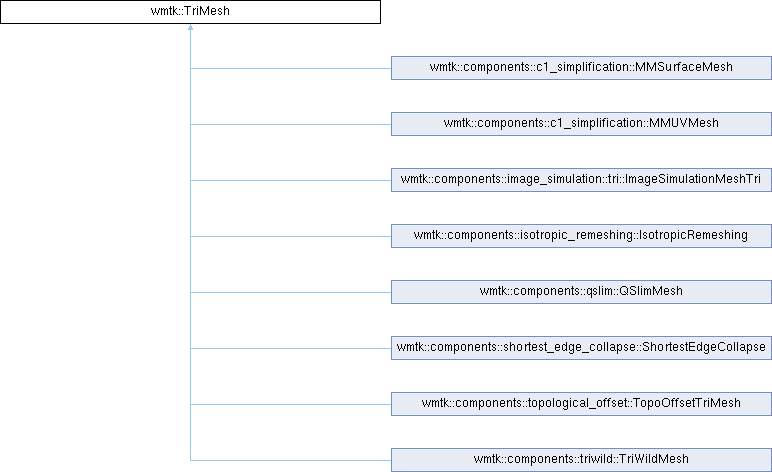
Classes | |
| struct | RingLockScratch |
| Per-thread buffers for the n-ring lock, so a lock acquisition allocates nothing. More... | |
| struct | SlotUsage |
| class | SmartTuple |
| class | TriangleConnectivity |
| class | Tuple |
| class | VertexConnectivity |
Public Types | |
| template<typename T > | |
| using | vector = std::vector< T > |
| using | VertexMutex = wmtk::threading::VertexMutex |
Public Member Functions | |
| void | init (size_t n_vertices, const std::vector< std::array< size_t, 3 > > &tris) |
| void | init (const MatrixXi &F) |
| Generate the connectivity of the mesh from an IGL-style F matrix. | |
| std::vector< Tuple > | get_vertices () const |
| std::vector< Tuple > | get_edges () const |
| std::vector< Tuple > | get_faces () const |
| Tuple | tuple_from_edge (size_t vid1, size_t vid2, size_t fid) const |
| Tuple | tuple_from_vids (size_t vid0, size_t vid1, size_t vid2) const |
| simplex::Vertex | simplex_from_vertex (const Tuple &t) const |
| simplex::Edge | simplex_from_edge (const Tuple &t) const |
| simplex::Face | simplex_from_face (const Tuple &t) const |
| simplex::Face | simplex_from_face (const size_t fid) const |
| Tuple | tuple_from_simplex (const simplex::Face &s) const |
| simplex::SimplexCollection | simplex_incident_triangles (const simplex::Vertex &v) const |
| simplex::SimplexCollection | simplex_incident_triangles (const simplex::Edge &e) const |
| simplex::SimplexCollection | simplex_link_vertices (const simplex::Vertex &v) const |
| simplex::SimplexCollection | simplex_link_vertices (const simplex::Edge &e) const |
| simplex::SimplexCollection | simplex_link_edges (const simplex::Vertex &v) const |
| void | set_preallocation_factor (double factor) |
| Preallocation factor: init/consolidate reserve capacity = max(floor, ceil(factor * live_count)) so operations can grab fresh slots without resizing the storage. When a pass exhausts the reserved capacity the affected operations fail (retried later after a consolidate). Values < 1 are clamped to 1. | |
| double | preallocation_factor () const |
| bool | slots_exhausted () const |
| void | clear_slots_exhausted () |
| size_t | request_tri_slots (size_t n) |
| size_t | request_vert_slots (size_t n) |
| virtual bool | invariants (const std::vector< Tuple > &) |
| User specified invariants that can't be violated. | |
| virtual bool | split_edge_before (const Tuple &t) |
| User specified preparations and desideratas for an edge split. | |
| virtual bool | split_edge_after (const Tuple &t) |
| User specified modifications and desideratas after an edge split. | |
| virtual bool | collapse_edge_before (const Tuple &t) |
| User specified preparations and desideratas for an edge collapse including the link check as collapse prerequisite. | |
| virtual bool | collapse_edge_after (const Tuple &t) |
| User specified modifications and desideratas after an edge collapse. | |
| virtual bool | swap_edge_after (const Tuple &t) |
| User specified modifications and desideras after an edge swap. | |
| virtual bool | swap_edge_before (const Tuple &t) |
| User specified preparations and desideratas for an edge swap including 1.can't swap on boundary edge. 2. when swap edge between v1, v2, there can't exist edges between the two opposite vertices v3, v4. | |
| virtual bool | smooth_before (const Tuple &t) |
| User specified preparations and desideratas for an edge smooth. | |
| virtual bool | smooth_after (const Tuple &t) |
| User specified modifications and desideras after an edge smooth. | |
| virtual bool | split_face_before (const Tuple &t) |
| User specified preparations and desideratas for a face split. | |
| virtual bool | split_face_after (const Tuple &t) |
| User specified modifications and desideratas after a face split. | |
| size_t | tri_capacity () const |
| get the current largest global fid | |
| size_t | vert_capacity () const |
| get the current largest global vid | |
| void | consolidate_mesh () |
| removing the elements that are removed | |
| void | remove_tris_by_ids (const std::vector< size_t > &fids) |
| Mark the given triangles, and any vertex left without an incident triangle, as removed. | |
| Tuple | switch_vertex (const Tuple &t) const |
| a duplicate of Tuple::switch_vertex funciton | |
| Tuple | switch_edge (const Tuple &t) const |
| a duplicate of Tuple::switch_edge funciton | |
| std::optional< Tuple > | switch_face (const Tuple &t) const |
| a duplicate of Tuple::switch_face funciton | |
| bool | check_link_condition (const Tuple &t) const |
| prerequisite for collapse | |
| void | set_use_link_condition (bool use_it) |
| Should collapse_edge_before enforce the link condition? | |
| bool | use_link_condition () const |
| bool | check_mesh_connectivity_validity () const |
| verify the connectivity validity of the mesh | |
| bool | check_edge_manifold () const |
| verify the edge manifoldness of the mesh | |
| size_t | edge_valence (const TriMesh::Tuple &t) const |
| Number of triangles incident to the edge the Tuple points at. | |
| bool | is_boundary_edge (const TriMesh::Tuple &t) const |
| Does exactly one triangle share this edge? | |
| bool | is_manifold_edge (const TriMesh::Tuple &t) const |
| Do exactly two triangles share this edge? | |
| size_t | vertex_component_count (const size_t vid) const |
| Number of edge-connected components in the fan of a vertex. | |
| size_t | vertex_component_count (const TriMesh::Tuple &t) const |
| bool | is_manifold_vertex (const size_t vid) const |
| std::optional< Tuple > | switch_component (const TriMesh::Tuple &t) const |
| Jump to the next edge-connected component of the fan of the Tuple's vertex. | |
| bool | is_boundary_vertex (const TriMesh::Tuple &t) const |
| check if the vertex that's represented by a Tuple is at the boundary of the mesh | |
| bool | split_edge (const Tuple &t, std::vector< Tuple > &new_t) |
| virtual bool | collapse_edge (const Tuple &t, std::vector< Tuple > &new_t) |
| void | collapse_edge_conn (const Tuple &loc0, std::vector< Tuple > &new_tris, Tuple &return_t, size_t &new_vid, std::vector< std::pair< size_t, TriangleConnectivity > > &old_tris, std::vector< std::pair< size_t, VertexConnectivity > > &old_vertices, std::vector< std::pair< size_t, size_t > > &same_edge_vid_fid, std::vector< size_t > &n12_intersect_fids) |
| void | collapse_edge_rollback (size_t &new_vid, std::vector< std::pair< size_t, TriangleConnectivity > > &old_tris, std::vector< std::pair< size_t, VertexConnectivity > > &old_vertices, std::vector< std::pair< size_t, size_t > > &same_edge_vid_fid, std::vector< size_t > &n12_intersect_fids) |
| bool | swap_edge (const Tuple &t, std::vector< Tuple > &new_t) |
| bool | smooth_vertex (const Tuple &t) |
| bool | split_face (const Tuple &t, std::vector< Tuple > &new_t) |
| Split a face in 3 faces. | |
| size_t | get_valence_for_vertex (const Tuple &t) const |
| Count the number of the one ring tris for a vertex. | |
| size_t | vertex_valence (const size_t vid) const |
| Number of triangles incident to a vertex, by id. | |
| std::vector< Tuple > | get_one_ring_tris_for_vertex (const Tuple &t) const |
| Get the one ring tris for a vertex. | |
| const std::vector< size_t > & | get_one_ring_fids_for_vertex (const Tuple &t) const |
| const std::vector< size_t > & | get_one_ring_fids_for_vertex (const size_t vid) const |
| std::vector< size_t > | get_one_ring_vids_for_vertex_duplicate (const size_t &t) const |
| Get the vids of the incident one ring tris for a vertex. | |
| void | get_one_ring_vids_for_vertex_duplicate (const size_t &t, std::vector< size_t > &one_ring) const |
| std::vector< size_t > | get_incident_fids_for_edge (const Tuple &t) const |
| std::vector< size_t > | get_incident_fids_for_edge (const size_t vid0, const size_t vid1) const |
| std::vector< Tuple > | get_one_ring_edges_for_vertex (const Tuple &t) const |
Get all edges that are incident to the vertex of Tuple t. | |
| std::vector< Tuple > | get_one_ring_edges_for_vertex (const size_t vid) const |
| std::array< Tuple, 3 > | oriented_tri_vertices (const Tuple &t) const |
| Get the incident vertices for a triangle. | |
| std::array< size_t, 3 > | oriented_tri_vids (const Tuple &t) const |
| Get the incident vertices for a triangle. | |
| std::array< size_t, 3 > | oriented_tri_vids (const size_t i) const |
| std::array< Tuple, 2 > | get_edge_vertices (const Tuple &t) const |
| std::array< size_t, 2 > | get_edge_vids (const Tuple &t) const |
| Tuple | tuple_from_tri (size_t fid) const |
| Tuple | tuple_from_vertex (size_t vid) const |
| Tuple | tuple_from_edge (size_t fid, size_t local_eid) const |
| std::tuple< Tuple, size_t > | tuple_from_edge (const std::array< size_t, 2 > &vids) const |
| std::optional< std::tuple< Tuple, size_t > > | try_tuple_from_edge (const std::array< size_t, 2 > &vids) const |
| tuple_from_edge for callers where a missing edge is an answer, not a bug. | |
| void | start_protect_attributes () |
| Start the phase where the attributes that will be modified can be recorded. | |
| void | release_protect_attributes () |
| End the modification phase. | |
| void | rollback_protected_attributes () |
| rollback the attributes that are modified if any condition failed | |
| int | release_vertex_mutex_in_stack () |
| int | release_vertex_mutex_to (size_t mark) |
Release the mutexes taken since the release stack held mark entries. | |
| bool | try_set_vertex_mutex_n_ring (const Tuple &v, int threadid, int n) |
Lock every vertex within graph distance n of v, the seed included. | |
| bool | try_set_vertex_mutex_n_ring (size_t vid, int threadid, int n) |
| bool | try_set_edge_mutex_n_ring (const Tuple &e, int threadid, int n) |
| try_set_vertex_mutex_n_ring seeded from both ends of an edge. | |
| bool | try_set_face_mutex_one_ring (const Tuple &f, int threadid) |
| try lock the one-ring neighboring triangles' incident vertices. | |
| void | for_each_face (const std::function< void(const Tuple &)> &) |
| perform the given function for each face | |
| void | for_each_edge (const std::function< void(const Tuple &)> &) |
| perform the given function for each edge | |
| void | for_each_vertex (const std::function< void(const Tuple &)> &) |
| perform the given function for each vertex | |
| virtual bool | vertex_is_on_surface (const size_t vid) const |
| Is a vertex part of the substructure. | |
| virtual bool | edge_is_on_surface (const std::array< size_t, 2 > &vids) const |
| Is an edge part of the substructure. | |
| simplex::SimplexCollection | get_surface_edges_for_vertex (const size_t vid) const |
| Get all edges on the surface that are incident to vid. | |
| size_t | get_order_of_edge (const std::array< size_t, 2 > &vids) const |
| Compute the order of an edge. | |
| size_t | get_order_of_vertex (const size_t vid) const |
| Get the order of a vertex. | |
| bool | substructure_link_condition (const Tuple &e_tuple) const |
| Link condition that also considers substructures. | |
Storage capacity | |
True if any slot request has been refused since the last clear. The pass boundary uses this to decide whether to consolidate: a refusal means an operation was abandoned for want of storage, and consolidating reclaims the slots that removed elements still hold (the counter only ever advances during a pass) and re-derives the capacity from the real element count. How many slots the storage holds, as opposed to tri_capacity()/vert_capacity(), which report the LIVE count – the end of the handed-out region. Exhaustion is | |
| size_t | tri_storage_capacity () const |
| size_t | vert_storage_capacity () const |
Ring lockers – NOT balls | |
The three helpers below are the ones every pass actually uses, and none of them claims the ball its name suggests. Each walks the ring with if (m_vertex_mutex[w].get_owner() == threadid) continue; and that This is deliberate, and swapping in try_set_vertex_mutex_n_ring is a performance regression, not a cleanup. Measured: routing the passes through the complete ball cost +80% wall clock on the 14 challenging tetwild models at 16 threads (844s -> 1522s) and -0.4% on the 16 challenging triwild ones. 3D is where it hurts, because a tet vertex has ~30 neighbours and the honest 2-ring ball is enormous next to what these claim. It is also a coverage-vs-name mismatch rather than a known race. What the operations rely on is that the whole ONE-ring of the seed simplex is held, and that they hold: the outer loops lock every unowned neighbour directly and only skip expanding through owned ones, so A caller that genuinely needs a complete ball asks for one explicitly. The coarsening pass does: it re-smooths a k-ring, so it writes the k-ring and reads the (k+1)-ring, well past what a plain collapse claims. | |
| bool | try_set_vertex_mutex_two_ring (const Tuple &v, int threadid) |
| Lock v's one-ring and, partially, its two-ring. See the note above. | |
| bool | try_set_edge_mutex_two_ring (const Tuple &e, int threadid) |
| Lock the edge's one-ring and, partially, its two-ring. See the note above. | |
| bool | try_set_vertex_mutex_one_ring (const Tuple &v, int threadid) |
| Lock v and its one-ring. Complete, unlike the two-ring pair. | |
Static Public Member Functions | |
| static bool | dry_run () |
| Whether operations on this thread are dry runs (see wmtk/OperationDryRun.hpp). | |
Public Attributes | |
| AbstractAttributeContainer * | p_vertex_attrs = nullptr |
| AbstractAttributeContainer * | p_edge_attrs = nullptr |
| AbstractAttributeContainer * | p_face_attrs = nullptr |
| bool | m_check_smoothing_stays_in_star = false |
| While true, smooth_vertex() checks that the smooth recorded nothing outside the vertex's star – the vertex itself and the edges, faces and triangles incident to it – and throws if it did. | |
| wmtk::threading::enumerable_thread_specific< std::vector< size_t > > | mutex_release_stack |
| int | NUM_THREADS = 0 |
Protected Member Functions | |
| virtual void | on_slot_storage_grown () |
| void | vertex_fan_components (size_t vid, std::vector< size_t > &component_of, std::vector< size_t > &representatives) const |
| void | resize_mutex (size_t v) |
Private Member Functions | |
| size_t | reserved_capacity (size_t live_count) const |
| size_t | get_next_empty_slot_t () |
| Get the next avaiblie global index for the triangle. | |
| size_t | get_next_empty_slot_v () |
| Get the next avaiblie global index for the vertex. | |
| bool | try_set_vertex_mutex (const Tuple &v, int threadid) |
| bool | try_set_vertex_mutex (size_t vid, int threadid) |
| void | unlock_vertex_mutex (const Tuple &v) |
| void | unlock_vertex_mutex (size_t vid) |
| bool | lock_vertex_ball (const size_t *seeds, size_t n_seeds, int threadid, int n, size_t mark) |
The n-ring BFS. mark is the release-stack watermark to unwind to on failure. | |
| void | check_smoothing_stayed_in_star (size_t vid) |
| See m_check_smoothing_stays_in_star; throws, after dropping the record, if the check fails. | |
Private Attributes | |
| SlotPool< VertexConnectivity > | m_vertex_connectivity |
| SlotPool< TriangleConnectivity > | m_tri_connectivity |
| double | m_preallocation_factor = 6.0 |
| bool | m_use_link_condition = true |
| std::vector< VertexMutex > | m_vertex_mutex |
| wmtk::threading::enumerable_thread_specific< RingLockScratch > | m_ring_lock_scratch |
Dimension-generic cell accessors | |
A "cell" is the top-dimensional element: a triangle here, a tet in TetMesh. These three members plus EDGES_PER_CELL are the whole interface the dimension-generic helpers in wmtk/utils (ParallelCollect, SizingField) need, so the same helper works on both meshes without traits or overloads. | |
| static constexpr int | EDGES_PER_CELL = 3 |
| size_t | cell_capacity () const |
| size_t | cell_storage_capacity () const |
| Tuple | tuple_from_cell (size_t cid) const |
Growing the storage at serial points | |
The storage cannot grow while operations run in parallel – growing reallocates it out from under concurrent readers – which is why it is preallocated. A serial pass has no concurrent readers, and between two of its operations nothing holds a reference into the storage either: so it can grow there, and only there, with no synchronisation at all. The scheduler does exactly that: before each operation of a serial pass it reserves cell_slot_bound() cells and one vertex. Every local operation creates its cells inside the stars of the vertices of its tuple's cell and adds at most one vertex, so the reservation covers whatever the operation requests, and a serial pass never refuses an operation for want of slots. The ids handed out are unchanged – the same counter, in the same order – so the result is the one an unbounded preallocation would give. With that in place a serial mesh only needs a small slack at init/consolidate, instead of the preallocation factor (see storage_grows_on_demand()). | |
| size_t | cell_slot_bound (const Tuple &t) const |
| void | reserve_free_slots (size_t cells, size_t verts) |
| virtual bool | storage_grows_on_demand () const |
| static SlotUsage | slot_usage_of_this_thread () |
Member Typedef Documentation
◆ VertexMutex
- See also
- wmtk::threading::VertexMutex. Aliased rather than nested so TriMesh and TetMesh cannot drift apart again – they already had.
Member Function Documentation
◆ cell_slot_bound()
| size_t TriMesh::cell_slot_bound | ( | const Tuple & | t | ) | const |
Upper bound on the fresh cell slots one local operation on t can take: the sum of the star sizes of the vertices of t's cell. t must be valid.
◆ check_link_condition()
| bool wmtk::TriMesh::check_link_condition | ( | const Tuple & | t | ) | const |
prerequisite for collapse
- Parameters
-
t Tuple referes to the edge to be collapsed
- Returns
- true is the link check is passed
◆ check_mesh_connectivity_validity()
| bool wmtk::TriMesh::check_mesh_connectivity_validity | ( | ) | const |
verify the connectivity validity of the mesh
- Note
- a valid mesh can have triangles that are is_removed == true
◆ collapse_edge()
Collapse an edge
- Parameters
-
t Input Tuple for the edge to be collapsed. [out] new_edges a vector of Tuples refering to the triangles incident to the new vertex introduced
- Note
- collapse edge a,b and generate a new vertex c
- Returns
- if collapse succeed
◆ collapse_edge_after()
|
inlinevirtual |
User specified modifications and desideratas after an edge collapse.
- Parameters
-
the edge Tuple to be collapsed
- Returns
- true if the modifications succeed
Reimplemented in wmtk::components::c1_simplification::MMUVMesh, wmtk::components::c1_simplification::MMSurfaceMesh, wmtk::components::isotropic_remeshing::IsotropicRemeshing, wmtk::components::qslim::QSlimMesh, wmtk::components::shortest_edge_collapse::ShortestEdgeCollapse, wmtk::components::topological_offset::TopoOffsetTriMesh, and wmtk::TriOptimizerMesh.
◆ collapse_edge_before()
|
inlinevirtual |
User specified preparations and desideratas for an edge collapse including the link check as collapse prerequisite.
- Parameters
-
the edge Tuple to be split
- Returns
- true if the preparation succeed
Reimplemented in wmtk::components::c1_simplification::MMUVMesh, wmtk::components::c1_simplification::MMSurfaceMesh, wmtk::components::isotropic_remeshing::IsotropicRemeshing, wmtk::components::qslim::QSlimMesh, wmtk::components::shortest_edge_collapse::ShortestEdgeCollapse, wmtk::components::topological_offset::TopoOffsetTriMesh, and wmtk::TriOptimizerMesh.
◆ collapse_edge_conn()
| void TriMesh::collapse_edge_conn | ( | const Tuple & | loc0, |
| std::vector< Tuple > & | new_tris, | ||
| Tuple & | return_t, | ||
| size_t & | new_vid, | ||
| std::vector< std::pair< size_t, TriangleConnectivity > > & | old_tris, | ||
| std::vector< std::pair< size_t, VertexConnectivity > > & | old_vertices, | ||
| std::vector< std::pair< size_t, size_t > > & | same_edge_vid_fid, | ||
| std::vector< size_t > & | n12_intersect_fids | ||
| ) |
Collpase an edge connectivity part
◆ collapse_edge_rollback()
| void TriMesh::collapse_edge_rollback | ( | size_t & | new_vid, |
| std::vector< std::pair< size_t, TriangleConnectivity > > & | old_tris, | ||
| std::vector< std::pair< size_t, VertexConnectivity > > & | old_vertices, | ||
| std::vector< std::pair< size_t, size_t > > & | same_edge_vid_fid, | ||
| std::vector< size_t > & | n12_intersect_fids | ||
| ) |
collapse edge rollback
◆ consolidate_mesh()
| void TriMesh::consolidate_mesh | ( | ) |
removing the elements that are removed
- Parameters
-
bnd_output when turn on will write the boundary vertices to "bdn_table.dmat"
◆ edge_is_on_surface()
|
inlinevirtual |
Is an edge part of the substructure.
- Parameters
-
vids The vertex IDs of the edge
Reimplemented in wmtk::components::topological_offset::TopoOffsetTriMesh, and wmtk::TriOptimizerMesh.
◆ edge_valence()
| size_t TriMesh::edge_valence | ( | const TriMesh::Tuple & | t | ) | const |
Number of triangles incident to the edge the Tuple points at.
1 on the boundary, 2 when manifold, more when not. O(valence).
◆ get_edges()
| std::vector< TriMesh::Tuple > TriMesh::get_edges | ( | ) | const |
Generate a vector of Tuples for each edge
- Note
- ensures the fid assigned is the smallest between faces adjacent to the edge
- Returns
- vector of Tuples refering to unique edges
◆ get_faces()
| std::vector< TriMesh::Tuple > TriMesh::get_faces | ( | ) | const |
Generate a vector of Tuples from global face index
- Note
- Local vid is the first of the m_idices Local eid assigned counter clockwise as in the ilustrated example
- Returns
- vector of Tuples refering to each face
◆ get_next_empty_slot_t()
|
private |
Get the next avaiblie global index for the triangle.
- Returns
- size_t
◆ get_next_empty_slot_v()
|
private |
Get the next avaiblie global index for the vertex.
- Returns
- size_t
◆ get_one_ring_edges_for_vertex()
| std::vector< wmtk::TriMesh::Tuple > TriMesh::get_one_ring_edges_for_vertex | ( | const Tuple & | t | ) | const |
Get all edges that are incident to the vertex of Tuple t.
The return tuples contain the edge and the adjacent vertex: return_tuple.switch_vertex().vid == t.vid()
- Parameters
-
t tuple pointing to a vertex
- Returns
- one-ring
The code below is a faster implementation but it did not give the exact same result for QSLIM. Leaving it commented out for now.
◆ get_one_ring_tris_for_vertex()
| std::vector< TriMesh::Tuple > TriMesh::get_one_ring_tris_for_vertex | ( | const Tuple & | t | ) | const |
Get the one ring tris for a vertex.
- Parameters
-
t tuple pointing to a vertex
- Returns
- a vector of Tuples refering to one-ring tris
◆ get_one_ring_vids_for_vertex_duplicate()
| std::vector< size_t > TriMesh::get_one_ring_vids_for_vertex_duplicate | ( | const size_t & | t | ) | const |
Get the vids of the incident one ring tris for a vertex.
- Parameters
-
t tuple pointing to a vertex
- Returns
- a vector of vids that can have duplicates
◆ get_order_of_edge()
| size_t TriMesh::get_order_of_edge | ( | const std::array< size_t, 2 > & | vids | ) | const |
Compute the order of an edge.
The order of an edge in a TriMesh is as follows: 0: the edge is not on the surface 1: the edge is on the surface
- Parameters
-
vids The vertex IDs of the edge
◆ get_order_of_vertex()
| size_t TriMesh::get_order_of_vertex | ( | const size_t | vid | ) | const |
Get the order of a vertex.
The order of a vertex in a TriMesh is as follows: 0: vertex is not on the surface 1: vertex is on the surface 2: vertex is a non-manifold vertex in the substructure
- Parameters
-
vid Vertex ID
◆ get_surface_edges_for_vertex()
| simplex::SimplexCollection TriMesh::get_surface_edges_for_vertex | ( | const size_t | vid | ) | const |
Get all edges on the surface that are incident to vid.
- Parameters
-
vid Vertex ID
◆ get_valence_for_vertex()
|
inline |
Count the number of the one ring tris for a vertex.
- Parameters
-
t tuple pointing to a vertex
- Returns
- one-ring tris number
◆ get_vertices()
| std::vector< TriMesh::Tuple > TriMesh::get_vertices | ( | ) | const |
Generate a vector of Tuples from global vertex index and local edge index
- Note
- Each vertex generate Tuple that has the smallest fid to be among incident triangles'. Local vid to be in the same order as thier indices in the m_conn_tris. Local eid assigned counter clockwise as in the ilustrated example
- Returns
- vector of Tuples refering to each vertex
◆ init() [1/2]
| void wmtk::TriMesh::init | ( | const MatrixXi & | F | ) |
Generate the connectivity of the mesh from an IGL-style F matrix.
- Parameters
-
F by 3 list of vertex indices.
◆ init() [2/2]
| void TriMesh::init | ( | size_t | n_vertices, |
| const std::vector< std::array< size_t, 3 > > & | tris | ||
| ) |
Generate the connectivity of the mesh
- Parameters
-
n_vertices Input number of vertices tris triangle connectivity
◆ invariants()
|
inlinevirtual |
User specified invariants that can't be violated.
- Parameters
-
std::vector<Tuple> a vector of Tuples that are concerned in a given operation
- Returns
- true if the invairnats are not violated
Reimplemented in wmtk::components::isotropic_remeshing::IsotropicRemeshing, wmtk::components::qslim::QSlimMesh, wmtk::components::shortest_edge_collapse::ShortestEdgeCollapse, and wmtk::components::topological_offset::TopoOffsetTriMesh.
◆ is_boundary_edge()
| bool TriMesh::is_boundary_edge | ( | const TriMesh::Tuple & | t | ) | const |
Does exactly one triangle share this edge?
- Parameters
-
t Tuple refering to an edge
◆ is_boundary_vertex()
|
inline |
◆ is_manifold_edge()
| bool TriMesh::is_manifold_edge | ( | const TriMesh::Tuple & | t | ) | const |
Do exactly two triangles share this edge?
Note that a boundary edge is not manifold by this definition; callers that need "manifold or boundary" should test is_manifold_edge(t) || is_boundary_edge(t).
Stops counting at three, so a pole with a large fan costs no more than a normal edge. swap_edge_before() asks this of every candidate edge.
◆ on_slot_storage_grown()
|
inlineprotectedvirtual |
Called after reserve_free_slots() grew the storage, for derived classes that keep per-slot side arrays.
Reimplemented in wmtk::TriOptimizerMesh.
◆ oriented_tri_vertices()
| std::array< wmtk::TriMesh::Tuple, 3 > TriMesh::oriented_tri_vertices | ( | const Tuple & | t | ) | const |
Get the incident vertices for a triangle.
- Parameters
-
t tuple pointing to an face
- Returns
- tuples of incident vertices
◆ oriented_tri_vids()
| std::array< size_t, 3 > TriMesh::oriented_tri_vids | ( | const Tuple & | t | ) | const |
Get the incident vertices for a triangle.
- Parameters
-
t tuple pointing to an face
- Returns
- global vids of incident vertices
◆ release_vertex_mutex_to()
| int TriMesh::release_vertex_mutex_to | ( | size_t | mark | ) |
Release the mutexes taken since the release stack held mark entries.
Unwinding to a watermark rather than clearing the whole stack is what lets one lock acquisition be composed out of several, and what lets a failed acquisition leave the caller's own locks alone. release_vertex_mutex_in_stack() is this with mark = 0.
◆ remove_tris_by_ids()
|
inline |
Mark the given triangles, and any vertex left without an incident triangle, as removed.
The 2D counterpart of TetMesh::remove_tets_by_ids, used by the output filters to drop the region outside the input. Call consolidate_mesh() afterwards to compact.
◆ reserve_free_slots()
| void TriMesh::reserve_free_slots | ( | size_t | cells, |
| size_t | verts | ||
| ) |
Serial points only: make cells fresh cell slots and verts fresh vertex slots available, growing the storage (connectivity and attributes) by at least half if not.
◆ set_use_link_condition()
|
inline |
Should collapse_edge_before enforce the link condition?
The link condition guarantees a collapse preserves the homotopy type and keeps the mesh a simplicial complex. Turning it off allows collapses that change topology and that create non-manifold edges and vertices, which the data structure now represents; the collapse itself still merges any duplicate triangles it produces so the result stays a simplicial complex.
Defaults to true, which is the historical behaviour of every caller.
◆ smooth_after()
|
inlinevirtual |
User specified modifications and desideras after an edge smooth.
- Parameters
-
the edge Tuple to be smoothed
- Returns
- true if the modifications succeed
Reimplemented in wmtk::components::isotropic_remeshing::IsotropicRemeshing, wmtk::components::topological_offset::TopoOffsetTriMesh, and wmtk::TriOptimizerMesh.
◆ smooth_before()
|
inlinevirtual |
User specified preparations and desideratas for an edge smooth.
- Parameters
-
the edge Tuple to be smoothed
- Returns
- true if the preparation succeed
Reimplemented in wmtk::components::isotropic_remeshing::IsotropicRemeshing, wmtk::components::topological_offset::TopoOffsetTriMesh, and wmtk::TriOptimizerMesh.
◆ smooth_vertex()
| bool TriMesh::smooth_vertex | ( | const Tuple & | t | ) |
Smooth a vertex
- Parameters
-
t Input Tuple for the vertex
- Note
- no geometry changed here
- Returns
- if smooth succeed
◆ split_edge()
Split an edge
- Parameters
-
t Input Tuple for the edge to split. [out] new_edges a vector of Tuples refering to the triangles incident to the new vertex introduced
- Returns
- if split succeed
◆ split_edge_after()
|
inlinevirtual |
User specified modifications and desideratas after an edge split.
- Parameters
-
the edge Tuple to be split
- Returns
- true if the modifications succeed
Reimplemented in wmtk::TriOptimizerMesh, wmtk::components::isotropic_remeshing::IsotropicRemeshing, and wmtk::components::topological_offset::TopoOffsetTriMesh.
◆ split_edge_before()
|
inlinevirtual |
User specified preparations and desideratas for an edge split.
- Parameters
-
the edge Tuple to be split
- Returns
- true if the preparation succeed
Reimplemented in wmtk::components::isotropic_remeshing::IsotropicRemeshing, wmtk::components::topological_offset::TopoOffsetTriMesh, and wmtk::TriOptimizerMesh.
◆ split_face()
Split a face in 3 faces.
- Parameters
-
t Input tuple for the face to split. [out] new_t A vector of Tuples refering to the triangles incident to the new vertex. introduced
- Returns
- true, if split succeed
   v2
   /|\
  / | \
 /  |  \
/f1 ^ f0\
/ / \ \ // f2 \ v0 --------— v1
◆ split_face_after()
|
inlinevirtual |
User specified modifications and desideratas after a face split.
- Parameters
-
the face Tuple to be split
- Returns
- true if the modifications succeed
Reimplemented in wmtk::components::topological_offset::TopoOffsetTriMesh.
◆ split_face_before()
|
inlinevirtual |
User specified preparations and desideratas for a face split.
- Parameters
-
the face Tuple to be split
- Returns
- true if the preparation succeed
Reimplemented in wmtk::components::topological_offset::TopoOffsetTriMesh.
◆ storage_grows_on_demand()
|
inlinevirtual |
Whether this mesh's passes run serially and so grow the storage on demand; if so, init/consolidate reserve a small slack instead of the preallocation factor.
Reimplemented in wmtk::TriOptimizerMesh.
◆ substructure_link_condition()
| bool TriMesh::substructure_link_condition | ( | const Tuple & | e_tuple | ) | const |
Link condition that also considers substructures.
Implementation based on the pseudo code from the paper: Vivodtzev et. al. - Substructure Topology Preserving Simplification of Tetrahedral Meshes
The math and the pseudo code in the paper contain errors! The theory itself is correct.
The link condition must be evaluated for the mesh and all substructures (surfaces, lines, points). If there is a substructure simplex in the star, the simplex is extended with a dummy vertex (e.g., an edge becomes a face) and this extended simplex must also be considered for the link.
◆ swap_edge()
Swap an edge
- Parameters
-
t Input Tuple for the edge to be swaped. [out] new_edges a vector of Tuples refering to the triangles incident to the new edge introduced
- Note
- swap edge a,b to edge c,d
- Returns
- if swap succeed
◆ swap_edge_after()
|
inlinevirtual |
User specified modifications and desideras after an edge swap.
- Parameters
-
the edge Tuple to be swaped
- Returns
- true if the modifications succeed
Reimplemented in wmtk::components::isotropic_remeshing::IsotropicRemeshing, wmtk::components::topological_offset::TopoOffsetTriMesh, and wmtk::TriOptimizerMesh.
◆ swap_edge_before()
|
virtual |
User specified preparations and desideratas for an edge swap including 1.can't swap on boundary edge. 2. when swap edge between v1, v2, there can't exist edges between the two opposite vertices v3, v4.
- Parameters
-
the edge Tuple to be swaped
- Returns
- true if the preparation succeed
Reimplemented in wmtk::components::isotropic_remeshing::IsotropicRemeshing, wmtk::components::topological_offset::TopoOffsetTriMesh, and wmtk::TriOptimizerMesh.
◆ switch_component()
| std::optional< TriMesh::Tuple > TriMesh::switch_component | ( | const TriMesh::Tuple & | t | ) | const |
Jump to the next edge-connected component of the fan of the Tuple's vertex.
The returned Tuple points at the same vertex but at a face that no sequence of switch_edge/switch_face can reach from t. Applying it once per component returns to the starting component. Returns nullopt when the vertex is manifold, i.e. when there is no other component to jump to.
◆ switch_face()
a duplicate of Tuple::switch_face funciton
- Note
- Returns nullptr if current Tuple referes to a boundary triangle
◆ tri_capacity()
|
inline |
get the current largest global fid
- Returns
- size_t
◆ try_set_face_mutex_one_ring()
| bool TriMesh::try_set_face_mutex_one_ring | ( | const Tuple & | f, |
| int | threadid | ||
| ) |
try lock the one-ring neighboring triangles' incident vertices.
- Parameters
-
f Tuple refers to the face threadid
- Returns
- true if all locked successfully
◆ try_set_vertex_mutex_n_ring()
| bool TriMesh::try_set_vertex_mutex_n_ring | ( | const Tuple & | v, |
| int | threadid, | ||
| int | n | ||
| ) |
Lock every vertex within graph distance n of v, the seed included.
A true breadth-first ball, expanded only through vertices this thread holds, so every connectivity read is made under a lock. On failure it releases exactly what it took and returns false; the caller must not assume anything about the mesh afterwards.
n == 0 locks the seed alone; n == 1 the seed and its one-ring, and so on. Sizing the ball is the caller's job: an operation must claim every vertex it READS as well as every vertex it writes, which for an operation that also re-smooths a k-ring means k+1 (smoothing a vertex reads its one-ring and writes the quality of its incident faces).
- Warning
- This is NOT a drop-in replacement for the *_two_ring / *_one_ring helpers below, which claim a strictly smaller set. Read the note on them before "simplifying" one into the other – it has a large, measured cost.
◆ try_tuple_from_edge()
| std::optional< std::tuple< TriMesh::Tuple, size_t > > TriMesh::try_tuple_from_edge | ( | const std::array< size_t, 2 > & | vids | ) | const |
tuple_from_edge for callers where a missing edge is an answer, not a bug.
The asserting form is right for the many callers that ask for an edge they know exists. collapse_edge_after is not one of them: it asks for an edge across the merged vertex that the collapse may have just removed, and it already has a branch for that case.
◆ tuple_from_edge() [1/2]
|
inline |
Generate a edge Tuple using global fid and local eid
- Parameters
-
fid globale fid for the triangle local_eid local eid
- Returns
- tuple refers to the edge
◆ tuple_from_edge() [2/2]
| TriMesh::Tuple TriMesh::tuple_from_edge | ( | size_t | vid1, |
| size_t | vid2, | ||
| size_t | fid | ||
| ) | const |
Generate a tuple using local vid and global fid
- Parameters
-
vid1,vid2 are local vids TODO: these are global vids fid globale fid for the triangle
- Note
- tuple refers to vid1
- Returns
- vector of Tuples
◆ tuple_from_tri()
|
inline |
◆ tuple_from_vertex()
|
inline |
Generate avertex Tuple using local vid and global fid
- Parameters
-
vid globale vid for the triangle
- Note
- tuple refers to vid
- Returns
- an invalid Tuple when vid is out of range, removed, or incident to no triangle – the same contract tuple_from_tri has always had.
The guard is not decoration. Without it this read m_vertex_connectivity[vid][0] unconditionally, and VertexConnectivity::operator[] only asserts, so in Release a removed or isolated vertex indexed an EMPTY vector: nullptr[0], i.e. a segfault. for_each_vertex builds a Tuple for every slot in [0, vert_capacity()) and only then asks is_valid, so any caller that ran it on an unconsolidated mesh crashed – 22 of 30 identical runs on Thingi-2D 193539, and 12 models into a 2333-model sweep.
◆ vert_capacity()
|
inline |
get the current largest global vid
- Returns
- size_t
◆ vertex_component_count()
| size_t TriMesh::vertex_component_count | ( | const size_t | vid | ) | const |
Number of edge-connected components in the fan of a vertex.
1 for a manifold vertex (and for a vertex on a non-manifold edge, whose faces are still joined through that edge), more for a pinch point. 0 for an isolated vertex.
◆ vertex_fan_components()
|
protected |
Edge-connected components of the fan of vid, as positions into that fan.
component_of[i] is the index into representatives of the component containing m_vertex_connectivity[vid].m_conn_tris[i], and representatives holds each component's smallest fid in increasing order. Two faces are in the same component when they share an edge containing vid.
Both outputs are sized by the fan rather than by the mesh, and nothing is cached: the fan is already the whole input, so recomputing costs the same as reading a stored answer would, minus the obligation to keep it current.
◆ vertex_is_on_surface()
|
inlinevirtual |
Is a vertex part of the substructure.
- Parameters
-
vid Vertex ID
Reimplemented in wmtk::components::topological_offset::TopoOffsetTriMesh, and wmtk::TriOptimizerMesh.
◆ vertex_valence()
|
inline |
Number of triangles incident to a vertex, by id.
The same count as get_valence_for_vertex, for callers that hold a vid rather than a Tuple. Around 6 on a well-shaped mesh; worth checking before anything that walks the one ring, since a degenerate mesh can push it much higher.
Member Data Documentation
◆ m_check_smoothing_stays_in_star
| bool wmtk::TriMesh::m_check_smoothing_stays_in_star = false |
While true, smooth_vertex() checks that the smooth recorded nothing outside the vertex's star – the vertex itself and the edges, faces and triangles incident to it – and throws if it did.
Set by a pass that smooths several vertices at once without locks (colored smoothing, see TriOptimizerMesh::smooth_vertices_colored). Two vertices it runs together share no simplex of their stars, but they can share a neighbour. A smoothing hook that reaches an attribute entry through non-const access records it, and a rejected smooth writes every recorded entry back – so an entry outside the star, such as a neighbour read as m_vertex_attribute[u] instead of through a const view, would be written by two threads at once. Hooks must read everything outside the star through const access; this turns a hook that does not into an error on its first such read, instead of a rare race.
The documentation for this class was generated from the following files:
- /home/runner/work/wildmeshing-toolkit/wildmeshing-toolkit/src/wmtk/TriMesh.h
- /home/runner/work/wildmeshing-toolkit/wildmeshing-toolkit/src/wmtk/TriMesh.cpp