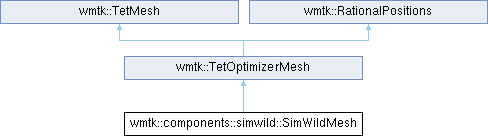
Classes | |
| struct | SplitTagCache |
| struct | SwapTagCache |
Public Types | |
| using | ExprPtr = expression_parser::ExpressionPtr |
| using | TetAttCol = wmtk::AttributeCollection< TetAttributes > |
 Public Types inherited from wmtk::TetOptimizerMesh | |
| using | FaceAttributes = wmtk::SurfaceTagAttributes |
| using | VertAttCol = AttributeCollection< VertexAttributes > |
| using | FaceAttCol = AttributeCollection< FaceAttributes > |
| using | EdgeAttCol = AttributeCollection< FeatureEdgeAttributes > |
| using | PositionKey = std::array< std::array< double, 3 >, 3 > |
| A tracked face by its corners' positions, sorted. | |
| using | SurfaceTopoSignature = wmtk::utils::SurfaceTopoSignature |
| using | FeaturePointAttCol = AttributeCollection< FeaturePointAttributes > |
| Public Types inherited from wmtk::TetMesh | |
| enum class | OpKind : int { split , collapse , swap_32 , swap_44 , swap_56 , swap_face , COUNT } |
| enum class | OpEvent : int { attempt , before_hook , link_condition , no_return_tet , duplicate_tet , topology , valence , boundary , exists , no_case_allowed , no_better_case , out_of_slots , after_hook , invariants , committed , screened , COUNT } |
| template<typename T > | |
| using | vector = std::vector< T > |
| using | VertexMutex = wmtk::threading::VertexMutex |
Public Member Functions | |
| InputSet | face_tag_mask () const |
| The face-tag bits of an input set: those below the number of face tags. | |
| void | init_label_envelopes (double eps, bool exact) |
| std::shared_ptr< Envelope > | surface_envelope_for_face (const std::array< size_t, 3 > &vids, const FaceAttributes &attr) const override |
| A tracked face's containment: its labels' envelopes if it has any, else m_envelope. | |
| std::shared_ptr< Envelope > | smoothing_energy_envelope (const size_t vid) const override |
| Envelope a vertex is pulled toward while smoothing. | |
| SimWildMesh (Parameters &_m_params, double envelope_eps, int _num_threads=0) | |
| double | cell_quality (const size_t tid) const override |
The quality of cell tid, and how to write it. | |
| void | set_cell_quality (const size_t tid, const double q) override |
| bool | allow_surface_swap () const override |
| bool | check_surface_topology () const override |
| void | create_mesh_attributes (const std::vector< VertexAttributes > &_vertex_attribute, const std::vector< TetAttributes > &_tet_attribute) |
| void | init_envelope (const MatrixXd &V, const MatrixXi &F) |
| CellTag | string_set_to_cell_tag (const std::set< std::string > &str_set) |
| void | set_sizing_field (const nlohmann::json &sizing_field_json) |
| void | set_quality_field (const nlohmann::json &quality_field_json) |
| double | target_quality (const size_t tid) const |
| double | target_quality (const Tuple &t) const |
| double | quality_rel (const size_t tid) const override |
| double | quality_rel (const Tuple &t) const |
| bool | check_mesh_quality (double &max_rel_quality, const bool verbose=false) const |
| bool | check_interface_faces_tagged (const bool verbose=false) const |
| Verify that every interface between unlike tags carries a surface face. | |
| void | update_attributes () override |
| Update the attributes of the mesh after an iteration of operations. | |
| std::array< size_t, 3 > | orient_tracked_face (const std::array< size_t, 3 > &f, const std::vector< size_t > &tets) const override |
| std::vector< int64_t > | tet_tags (size_t tid) const override |
| A tet's tags: the regions of a volume history are the tag sets. | |
| std::vector< size_t > | active_vertices () const override |
| void | simplify () |
| bool | all_rounded () const |
| Check if all vertices of the mesh are rounded. | |
| void | init_from_image (const MatrixXr &V, const MatrixXi &T, const MatrixSi &T_tags, const std::vector< std::string > &tag_names, const MatrixXi &F_tagged=MatrixXi(), const MatrixSi &F_tags=MatrixSi(), const std::vector< std::string > &face_tag_names={}) |
| Init from meshes image. | |
| void | init_from_image (const MatrixXd &V, const MatrixXi &T, const MatrixSi &T_tags, const std::vector< std::string > &tag_names, const MatrixXi &F_tagged=MatrixXi(), const MatrixSi &F_tags=MatrixSi(), const std::vector< std::string > &face_tag_names={}) |
| void | init_surfaces_and_boundaries () |
| void | init_face_tags (const MatrixXi &F_tagged, const MatrixSi &F_tags, const std::vector< std::string > &face_tag_names) |
| size_t | refine_sizing_around_worst (double max_metric=0.) override |
| Escape a stuck max energy by refining the sizing field around the worst elements. | |
| void | find_order_2_edges () |
| Find open boundary edges of the embedded surface and initialize a BVH for the open boundary. | |
| bool | is_order_2_edge (const Tuple &e) const |
| Checks if an edge COULD be an open boundary edge. | |
| bool | is_order_2_edge (const std::array< size_t, 2 > &e) const |
| void | write_vtu (const std::string &path, MeshMap *output=nullptr) |
| void | write_surface (const std::string &path) const |
| void | init_vertex_order () |
| Compute the vertex order for every vertex. | |
| double | tet_volume (const size_t tid) const |
| std::vector< ConnectedComponent > | compute_connected_components (const CellTag &tag_in) const |
Find all connected components that contain the tag_in tags. | |
| std::vector< ConnectedComponent > | compute_connected_components (const ExprPtr &expr) const |
| std::vector< ConnectedComponent > | find_holes (const std::vector< CellTag > &tag_in) const |
Find all regions that do not contain the tags from tag_in. | |
| void | compute_tag_boundary (const CellTag &tag, MatrixXd &V, MatrixXi &F) const |
| Compute the boundary of a tag. | |
| void | keep_largest_connected_component (const std::vector< CellTag > &lcc_tags, const size_t n_lcc=1) |
| Keep only the largest connected component for each of the distinct tag_0 values, and engulf all other components. | |
| void | fill_holes_topo (const std::vector< CellTag > &fill_holes_tags, double threshold=std::numeric_limits< double >::infinity()) |
| void | seal_connected_components (const std::vector< CellTag > &tag_sets, const std::vector< ConnectedComponent > &components) |
| void | tight_seal_topo (const std::vector< std::vector< CellTag > > &tight_seal_tag_sets, double threshold=std::numeric_limits< double >::infinity()) |
| void | resolve_overlaps (const std::vector< std::array< ExprPtr, 2 > > &intersecting_tags) |
| void | replace_tags (const std::vector< CellTag > &tags_in, const std::vector< CellTag > &tags_out) |
| void | tag_priority (const std::vector< int64_t > &tags) |
| Gives tags priority over others. | |
| std::array< size_t, 3 > | orient_tracked_face (const std::array< size_t, 3 > &f, const std::vector< size_t > &tets) const override |
| virtual std::array< size_t, 3 > | orient_tracked_face (const std::array< size_t, 3 > &f, const std::vector< size_t > &tets) const |
| std::array< size_t, 3 > | orient_tracked_face (const std::array< size_t, 3 > &f) const |
| Public Member Functions inherited from wmtk::TetOptimizerMesh | |
| std::vector< std::array< size_t, 3 > > | oriented_tracked_faces () const |
| The tracked surface as an oriented soup: each tracked face emitted |m_orientation| times, in the orientation the input gave it. Faces whose sheets cancel are left out. Vertex ids index m_vertex_attribute. | |
| std::vector< std::pair< std::array< size_t, 2 >, int > > | tracked_surface_boundary () const |
| Mesh edges where the oriented tracked surface has a boundary. | |
| void | throw_if_in_operation_pass (const char *call) const |
| void | add_edge_attributes (AbstractAttributeContainer *c) |
| Register an edge collection with m_edge_attr_group and point p_edge_attrs at the group. | |
| void | enable_feature_edge_tracking () |
| Turn on feature-edge tracking. The collection joins m_edge_attr_group beside whatever the application registered there. | |
| bool | vertex_has_feature_edge (size_t vid) const |
| size_t | substructure_order_of_edge (const std::array< size_t, 2 > &vids) const override |
| The orders substructure_link_condition consults, overridable so an application can widen the 1D substructure beyond what the surface complex derives. | |
| size_t | substructure_order_of_vertex (size_t vid) const override |
| void | substructure_feature_neighbors (size_t vid, std::vector< size_t > &out) const override |
One-ring vertices x of vid where (vid, x) is 1D substructure NOT derivable from the surface complex (feature edges through the interior, for instance). The link condition's order-2 edge collection walks surface faces and would never see them. | |
| bool | feature_edges_at_vertex_inside (size_t vid) const |
| virtual bool | smoothing_position_is_allowed (const size_t vid, const Vector3d &p) const |
| bool | is_force_split_edge (const size_t v1, const size_t v2) const |
| bool | storage_grows_on_demand () const override |
| bool | split_edge_is_due (const Tuple &e) const |
| TetOptimizerMesh (OptimizerParameters ¶ms, std::shared_ptr< Envelope > env) | |
| void | compute_vertex_partition () |
| void | compute_vertex_partition_morton () |
| size_t | get_partition_id (const Tuple &loc) const |
| double | get_length2 (const Tuple &l) const |
| bool | is_inverted (const std::array< size_t, 4 > &vs) const |
| bool | is_inverted (const Tuple &loc) const |
| bool | is_inverted_f (const Tuple &loc) const |
| Inversion check using only the double positions. | |
| double | get_quality (const std::array< size_t, 4 > &vs) const |
| double | get_quality (const Tuple &loc) const |
| std::tuple< double, double > | get_max_avg_energy () |
| void | update_attributes_and_history () |
| update_attributes(), then the change it made to the tracked surface, if recording one. | |
| void | record_surface_history (const std::string &metadata) |
| std::optional< history::SurfaceHistory > | finish_surface_history (const history::SurfaceHistory *input=nullptr) |
| Bring the recorded surface up to date with the tracked faces, stop recording, log what the history holds and return it, for the application to save (ComponentIO:: save_history). None if not recording. | |
| void | record_volume_history () |
| std::optional< std::vector< uint8_t > > | finish_volume_history (const std::map< int64_t, std::string > &tag_names={}) |
| bool | is_tracked_face (size_t tid, int j) const override |
| The faces with m_is_surface_fs, for a surface history (TetMesh::start_surface_history). | |
| std::array< size_t, 3 > | orient_tracked_face (const std::array< size_t, 3 > &f, const std::vector< size_t > &tets) const override |
| std::vector< std::array< size_t, 2 > > | tracked_feature_edges () const override |
| The tagged feature edges (m_feature_edge_attribute) that are edges of tracked faces. | |
| bool | checks_tracked_surface () const override |
| m_params.check_surface_folds; see there. | |
| void | tracked_surface_before (const std::vector< size_t > &vs, bool all) override |
| bool | tracked_surface_after (const std::vector< size_t > &vs, bool all) override |
| Eigen::Vector3d | tracked_area_normal (const std::vector< std::array< size_t, 3 > > &faces) const |
| size_t | tracked_not_facing (const std::vector< std::array< size_t, 3 > > &faces, const Eigen::Vector3d &n) const |
| size_t | tracked_star_folds (const std::vector< std::array< size_t, 3 > > &faces) const |
| void | mesh_improvement (int max_its=80) |
| std::tuple< double, double > | local_operations (const std::array< int, 4 > &ops, bool collapse_limit_length=true) |
| bool | round (const Tuple &v) |
| Round a vertex position to floating point, if that inverts no incident tet. | |
| bool | is_edge_on_surface (const Tuple &loc) |
| bool | is_edge_on_bbox (const Tuple &loc) |
| virtual bool | is_open_boundary_edge (const Tuple &e) |
Whether edge e lies on the boundary of the tracked surface. | |
| int | edge_incident_surface_face_count (const Tuple &e) |
How many of the faces incident to edge e are on the tracked surface. | |
| bool | surface_triangle_is_outside (const size_t a, const size_t b, const size_t c, const FaceAttributes &attr) const |
| bool | vertex_is_on_surface (const size_t vid) const override |
| Is a vertex part of the substructure. | |
| bool | face_is_on_surface (const size_t fid) const override |
| Is a face part of the substructure. | |
| size_t | get_order_of_vertex (const size_t vid) const override |
| Get the order of a vertex. | |
| std::vector< std::array< size_t, 3 > > | get_faces_by_condition (std::function< bool(const FaceAttributes &)> cond) const |
| void | output_faces (std::string file, std::function< bool(const FaceAttributes &)> cond) |
| void | gradation_smooth_sizing (double grade, const std::vector< size_t > &seeds) |
| Grade the refined sizing region into its surroundings (monotone, only lowers). | |
| double | active_quality_threshold () const |
| Cell-quality threshold above which a tet is "active" (worth operating on) for the skip-good-regions filter. | |
| void | split_all_edges () |
| bool | split_edge_before (const Tuple &t) override |
| User specified preparations and desideratas for an edge split before changing the connectivity. | |
| bool | split_edge_after (const Tuple &loc) override |
| This function computes the attributes for the added simplices. User specified modifications and desideratas for after an edge split. | |
| void | collapse_all_edges (bool is_limit_length=true) |
| bool | collapse_edge_before (const Tuple &t) override |
| User specified preparations and desideratas for an edge collapse before changing the connectivity. | |
| bool | collapse_edge_after (const Tuple &t) override |
| User specified modifications and desideratas for after an edge collapse. | |
| size_t | coarsen_mesh () |
| Coarsen the mesh without letting the max energy rise. | |
| bool | coarsen_collapse_edge (const Tuple &e, std::vector< Tuple > &new_tets) |
| One collapse under the coarsening rules, outside a coarsening pass. | |
| size_t | swap_all_edges_32 () |
| bool | swap_edge_before (const Tuple &t) override |
| User specified preparations and desideratas for an 3-2 edge swap before changing the conenctivity. | |
| bool | swap_edge_after (const Tuple &t) override |
| User specified modifications and desideratas for after a 3-2 edge swap. | |
| size_t | swap_all_edges_44 () |
| bool | swap_edge_44_before (const Tuple &t) override |
| User specified preparations and desideratas for an 4-4 edge swap before changing the connectivity. | |
| bool | swap_edge_44_accept_case (const std::array< size_t, 2 > &new_edge) override |
| Filter which of the 4-4 orientations may be chosen. | |
| bool | swap_edge_44_after (const Tuple &t) override |
| User specified modifications and desideratas for after a 4-4 edge swap. | |
| size_t | swap_all_edges_56 () |
| bool | swap_edge_56_before (const Tuple &t) override |
| User specified preparations and desideratas for a 5-6 edge swap before changing the connectivity. | |
| bool | swap_edge_56_accept_case (const std::array< size_t, 3 > &new_face) override |
| Filter which of the 5-6 orientations may be chosen. | |
| bool | swap_edge_56_after (const Tuple &t) override |
| User specified modifications and desideratas for after a 5-6 edge swap. | |
| size_t | swap_all_faces () |
| bool | swap_face_before (const Tuple &t) override |
| User specified preparations and desideratas for an 2-3 face swap befroe changing the geometry. | |
| bool | swap_face_after (const Tuple &t) override |
| User specified modifications and desideratas for after a 2-3 face swap. | |
| size_t | swap_all_edges_all () |
| bool | prepare_surface_flip (const Tuple &t, const std::vector< size_t > &incident_tets) |
| SurfaceTopoSignature | surface_topology_signature () const |
| void | warn_if_surface_topology_changed (const SurfaceTopoSignature &before, const char *where) const |
| double | swap_edge_44_energy (const std::vector< std::array< size_t, 4 > > &tets, const int op_case) override |
| User specified energy to decide which of the 4 possible orientations should be chosen. | |
| double | swap_edge_56_energy (const std::vector< std::array< size_t, 4 > > &tets, const int op_case) override |
| User specified energy to decide which of the 5 possible orientations should be chosen. | |
| virtual std::shared_ptr< Envelope > | smoothing_containment_envelope (const size_t, const std::array< size_t, 3 > &face, const FaceAttributes &attr) const |
Envelope the smoother checks tracked face face (attributes attr) at the moved vertex vid against; null skips the face. | |
| virtual bool | boundary_edges_at_vertex_inside (size_t) const |
| virtual std::shared_ptr< polysolve::nonlinear::Problem > | smoothing_extra_energy (const size_t) const |
| An extra term the application adds to this vertex's smoothing objective, or null. | |
| virtual double | smoothing_cell_energy (const size_t, const double quality) const |
| The number the shared smoother compares for one cell, given the cell's quality (AMIPS^3) at the position being tested. Its quality veto compares the max of this over the ring before and after the move, and the default smoothing_ring_energy() is the same max. | |
| virtual double | smoothing_ring_energy (const std::vector< Tuple > &ring, const bool stored) const |
| The number the shared smoother's projected step compares for a whole one-ring: a vertex held on a surface takes the first projected candidate whose value is strictly below the value before the move. | |
| bool | smooth_before (const Tuple &t) override |
The smoothing hooks. A derived class overriding them – or invariants(), which a smooth also runs – must read every attribute outside the smoothed vertex's star (other vertices, and the edges, faces and tets not incident to the vertex) through const access, e.g. std::as_const(m_vertex_attribute)[u]. | |
| bool | smooth_after (const Tuple &t) override |
| User specified modifications and desideratas for after smoothing a vertex. | |
| void | smooth_all_vertices (const size_t n_iters=1) |
| bool | use_colored_smoothing () const |
| Whether this pass smooths by color class (see OptimizerParameters::colored_smoothing). | |
| void | smooth_vertices_colored (const std::vector< std::pair< std::string, Tuple > > &ops) |
One smoothing sweep over ops (all "vertex_smooth"), one color class at a time. | |
| virtual void | log_smoothing_pass_accounting () |
| virtual void | smoothing_pass_done () |
| bool | invariants (const std::vector< Tuple > &t) override |
| virtual std::array< size_t, 3 > | orient_tracked_face (const std::array< size_t, 3 > &f, const std::vector< size_t > &tets) const |
| std::array< size_t, 3 > | orient_tracked_face (const std::array< size_t, 3 > &f) const |
| void | enable_feature_point_tracking (const bool preserve) |
Turn on feature-point tracking, and the policy when preserve. | |
| bool | collapse_breaks_feature_point (const size_t v1_id, const size_t v2_id) const |
| bool | feature_point_ball_contains (const size_t vid, const Vector3d &p) const |
| std::pair< size_t, size_t > | feature_retention (double *worst_ratio=nullptr) const |
| Public Member Functions inherited from wmtk::TetMesh | |
| size_t | vert_capacity () const |
| get the current largest global vid | |
| size_t | tet_capacity () const |
| get the current largest global tid | |
| size_t | vertex_size () const |
| get the number of unremoved verticies | |
| size_t | tet_size () const |
| get the number of unremoved tets | |
| void | init (size_t n_vertices, const std::vector< std::array< size_t, 4 > > &tets) |
| void | init_with_isolated_vertices (size_t n_vertices, const std::vector< std::array< size_t, 4 > > &tets) |
| void | init (const MatrixXi &T) |
| Generate the connectivity of the mesh from an IGL-style T matrix. | |
| bool | split_edge (const Tuple &t, std::vector< Tuple > &new_tets) |
| virtual bool | collapse_edge (const Tuple &t, std::vector< Tuple > &new_tets) |
| bool | link_condition (const Tuple &t) |
| bool | collapse_edge_conn (const Tuple &loc0, size_t &v1_id, Tuple &new_loc, std::map< size_t, wmtk::TetMesh::VertexConnectivity > &rollback_vert_conn, std::vector< size_t > &n1_t_ids_copy, std::vector< size_t > &new_tet_id, std::vector< TetrahedronConnectivity > &old_tets) |
| bool | collapse_edge_check_topology (const std::vector< size_t > &new_tet_id) |
| Check topology after collapse connectivity change. This is a sanity check and should not be necessary. | |
| void | collapse_edge_rollback (size_t &v1_id, std::map< size_t, wmtk::TetMesh::VertexConnectivity > &rollback_vert_conn, std::vector< size_t > &n1_t_ids, std::vector< size_t > &new_tet_id, std::vector< TetrahedronConnectivity > &old_tets) |
| bool | swap_edge_56 (const Tuple &t, std::vector< Tuple > &new_tets) |
| bool | swap_edge_44 (const Tuple &t, std::vector< Tuple > &new_tets) |
| bool | swap_edge (const Tuple &t, std::vector< Tuple > &new_tets) |
| 3-2 edge swap | |
| bool | swap_face (const Tuple &t, std::vector< Tuple > &new_tets) |
| 2-3 face swap | |
| bool | smooth_vertex (const Tuple &t) |
| bool | split_tet (const Tuple &t, std::vector< Tuple > &new_tets) |
| Split a tet in 4 tets. | |
| bool | split_face (const Tuple &t, std::vector< Tuple > &new_tets) |
| Split a face in 3 faces. | |
| void | triangle_insertion (const std::vector< Tuple > &intersected_tets, const std::vector< Tuple > &intersected_edges, std::vector< size_t > &new_edge_vids, std::vector< size_t > &new_center_vids, std::vector< std::array< size_t, 4 > > ¢er_split_tets) |
| Insert a triangle into a tetmesh, with known intersection information. | |
| bool | insert_point (const Tuple &t, std::vector< Tuple > &new_tets) |
| Insert a point into a tetmesh inside a tet. In general position, this split a tet into 4. In face position, split two tets. In edge position, In point position, do nothing. It has no surface history hooks, and throws while a surface history is recording. | |
| virtual bool | insert_point_before (const Tuple &t) |
| virtual bool | insert_point_after (std::vector< Tuple > &new_tets) |
| void | consolidate_mesh () |
| cleans up the deleted vertices or tetrahedra, fixes the corresponding indices, and reset the version number. WARNING: it invalidates all tuples! | |
| std::shared_ptr< history::TrackedSurfaceRecorder > | start_surface_history (std::function< Eigen::Vector3d(size_t)> position) |
| Record every change to the tracked surface from now on (see wmtk/history/TrackedRecorder.hpp). | |
| void | stop_surface_history () |
| Stop recording. The recorder keeps what it has. | |
| size_t | resync_surface_history () |
| std::shared_ptr< history::VolumeRecorder > | start_volume_history (std::function< Eigen::Vector3d(size_t)> position) |
Record, alongside the surface history, the tets around every operation that changes the tracked surface (wmtk/history/VolumeHistory.hpp): what a map of the volume needs. The surface history must be recording; a volume history is its own choice, since it takes far more room. position(v) is called as start_surface_history()'s is; a tet's region is its tet_tags(). | |
| void | stop_volume_history () |
| Stop recording the volume. The recorder keeps what it has. | |
| std::vector< std::array< size_t, 3 > > | tracked_faces () const |
| Every tracked face, oriented by orient_tracked_face(). | |
| std::array< size_t, 3 > | orient_tracked_face (const std::array< size_t, 3 > &f) const |
| orient_tracked_face, finding the face's tets. | |
| std::array< size_t, 3 > | face_out_of (size_t tid, const std::array< size_t, 3 > &face) const |
The corners of face, a face of tet tid, ordered so that its normal points out of the tet – for a tet the right way round as TetOptimizerMesh has them, with its fourth vertex on the side of the first three's normal (orient3d negative). | |
| std::vector< size_t > | tets_of_face (const std::array< size_t, 3 > &f) const |
The tets with the face f, sorted: one on the boundary, two inside. | |
| std::vector< Tuple > | get_edges () const |
| std::vector< Tuple > | get_faces () const |
| std::vector< Tuple > | get_vertices () const |
| std::vector< Tuple > | get_tets () const |
| virtual void | for_each_face (const std::function< void(const TetMesh::Tuple &)> &) |
| looping through all the unique edges and perform the given function | |
| void | set_preallocation_factor (double factor) |
| Preallocation factor: init/consolidate reserve capacity = max(floor, ceil(factor * live_count)) so operations can grab fresh slots without resizing the storage. When a pass exhausts the reserved capacity the affected operations fail (and are retried later after a consolidate). Tune per application (e.g. from JSON); values < 1 are clamped to 1. | |
| double | preallocation_factor () const |
| bool | slots_exhausted () const |
| void | clear_slots_exhausted () |
| size_t | request_tet_slots (size_t n) |
| size_t | request_vert_slots (size_t n) |
| void | ensure_free_tet_capacity (size_t extra) |
| void | ensure_free_vert_capacity (size_t extra) |
| bool | op_refused (const OpKind k, const OpEvent e) const |
op_event() for a refusal, returning false so a site reads return op_refused(...). | |
| bool | op_screened (const OpKind k) const |
| The end of a dry run that would have gone on to change the mesh: true, and counted. | |
| Tuple | tuple_from_edge (size_t tid, int local_eid) const |
| get a Tuple from global tetra index and local edge index (from 0-5). | |
| Tuple | tuple_from_edge (const std::array< size_t, 2 > &vids) const |
| get a Tuple from global vids of the 2 end of an edge | |
| Tuple | tuple_from_face (size_t tid, int local_fid) const |
| get a Tuple from global tetra index and local face index (from 0-3). | |
| std::tuple< Tuple, size_t > | tuple_from_face (const std::array< size_t, 3 > &vids) const |
| get a Tuple and the global face index from global vertex index of the face. | |
| std::optional< std::tuple< Tuple, size_t > > | try_tuple_from_face (const std::array< size_t, 3 > &vids) const |
| tuple_from_face for callers where a missing face is an answer, not a bug. | |
| size_t | lowest_common_tet (size_t v0_id, size_t v1_id, size_t v2_id) const |
| Lowest tet id incident to all three vertices, or size_t(-1) if there is none. | |
| size_t | vertex_valence (const size_t vid) const |
| Number of tets incident to a vertex, in O(1). | |
| std::tuple< Tuple, size_t > | tuple_from_face (const simplex::Face &f) const |
| Tuple | tuple_from_vertex (size_t vid) const |
| get a Tuple from global vertex index | |
| Tuple | tuple_from_tet (size_t tid) const |
| get a Tuple from global tetra index | |
| Tuple | tuple_from_vids (size_t vid0, size_t vid1, size_t vid2, size_t vid3) const |
| Get a Tuple from global vertex IDs. | |
| simplex::Tet | simplex_from_tet (const Tuple &t) const |
| simplex::Tet | simplex_from_tet (const size_t tid) const |
| simplex::Face | simplex_from_face (const Tuple &t) const |
| simplex::Edge | simplex_from_edge (const Tuple &t) const |
| Tuple | switch_vertex (const Tuple &t) const |
| wrapper function from Tuple::switch_vertex | |
| Tuple | switch_edge (const Tuple &t) const |
| wrapper function from Tuple::switch_edge | |
| Tuple | switch_face (const Tuple &t) const |
| wrapper function from Tuple::switch_face | |
| std::optional< Tuple > | switch_tetrahedron (const Tuple &t) const |
| wrapper function from Tuple::switch_tetrahedron | |
| std::vector< Tuple > | get_one_ring_tets_for_vertex (const Tuple &t) const |
| Get the one ring tets for a vertex. | |
| const std::vector< size_t > & | get_one_ring_tids_for_vertex (const Tuple &t) const |
| Get the one ring tids for vertex. | |
| const std::vector< size_t > & | get_one_ring_tids_for_vertex (const size_t vid) const |
| std::vector< Tuple > | get_one_ring_vertices_for_vertex (const Tuple &t) const |
| Get the one ring vertices for a vertex. | |
| std::vector< size_t > | get_one_ring_vids_for_vertex (size_t vid, std::vector< size_t > &cache) |
| Get the one ring vids for vertex. | |
| std::vector< size_t > | get_one_ring_vids_for_vertex (size_t vid) const |
| Get the one ring vids for vertex. | |
| std::vector< size_t > | get_one_ring_vids_for_vertex_adj (size_t vid) const |
| Duplicate of the function TetMesh::get_one_ring_vids_for_vertex. | |
| std::vector< size_t > | get_one_ring_vids_for_vertex_adj (size_t vid, std::vector< size_t > &cache) |
| Duplicate of the function TetMesh::get_one_ring_vids_for_vertex. | |
| std::vector< Tuple > | get_incident_tets_for_edge (const Tuple &t) const |
| Get the incident tets for edge. | |
| std::vector< Tuple > | get_incident_tets_for_edge (const size_t vid0, const size_t vid1) const |
| std::vector< size_t > | get_incident_tids_for_edge (const Tuple &t) const |
| std::vector< size_t > | get_incident_tids_for_edge (const size_t vid0, const size_t vid1) const |
| std::vector< Tuple > | get_one_ring_tets_for_edge (const Tuple &t) const |
| Get the one ring tets for edge. | |
| std::vector< std::array< size_t, 3 > > | vertex_adjacent_boundary_faces (const Tuple &t) const |
| std::array< Tuple, 4 > | oriented_tet_vertices (const Tuple &t) const |
| std::array< size_t, 4 > | oriented_tet_vids (const Tuple &t) const |
| std::array< size_t, 4 > | oriented_tet_vids (const size_t tid) const |
| std::array< Tuple, 3 > | get_face_vertices (const Tuple &t) const |
| Get the 3 vertices of a face represented by Tuple. | |
| std::array< size_t, 3 > | get_face_vids (const Tuple &t) const |
| std::array< Tuple, 6 > | tet_edges (const Tuple &t) const |
| get the 6 edges of a tet represented by Tuples | |
| void | check_tuple_validity (const Tuple &t) const |
| bool | check_mesh_connectivity_validity () const |
| checks the validity of the connectivity of the mesh. Including the validity of each Tuple | |
| void | remove_tets_by_ids (const std::vector< size_t > &tids) |
| remove the tetrahedrons in the mesh that have given tet ids | |
| void | start_protect_attributes () |
| void | release_protect_attributes () |
| void | rollback_protected_attributes () |
| int | release_vertex_mutex_in_stack () |
| int | release_vertex_mutex_to (size_t mark) |
Release the mutexes taken since the release stack held mark entries. | |
| bool | try_set_vertex_mutex_n_ring (const Tuple &v, int threadid, int n) |
Lock every vertex within graph distance n of v, the seed included. | |
| bool | try_set_vertex_mutex_n_ring (size_t vid, int threadid, int n) |
| bool | try_set_edge_mutex_n_ring (const Tuple &e, int threadid, int n) |
| try_set_vertex_mutex_n_ring seeded from both ends of an edge. | |
| bool | try_set_face_mutex_n_ring (size_t v1, size_t v2, size_t v3, int threadid, int n) |
| try_set_vertex_mutex_n_ring seeded from the three vertices of a face. | |
| void | for_each_edge (const std::function< void(const TetMesh::Tuple &)> &) |
| perform the given function for each edge | |
| void | for_each_vertex (const std::function< void(const TetMesh::Tuple &)> &) |
| perform the given function for each vertex | |
| void | for_each_tetra (const std::function< void(const TetMesh::Tuple &)> &) |
| perform the given function for each tet | |
| simplex::SimplexCollection | get_surface_faces_for_vertex (const size_t vid) const |
| Get all faces on the surface that are incident to vid. | |
| simplex::SimplexCollection | get_surface_faces_for_edge (const std::array< size_t, 2 > &vids) const |
| Get all faces on the surface that are incident to the edge. | |
| size_t | get_num_surface_faces_for_edge (const std::array< size_t, 2 > &vids) const |
| Get the number of surface faces incident to the edge. | |
| size_t | compute_vertex_order (const size_t vid) const |
| Compute the vertex order for a single vertex. | |
| size_t | get_order_of_edge (const std::array< size_t, 2 > &vids) const |
| Compute the order of an edge. | |
| bool | substructure_link_condition (const Tuple &e_tuple) const |
| Link condition that also considers substructures. | |
| size_t | tet_storage_capacity () const |
| size_t | vert_storage_capacity () const |
| bool | try_set_vertex_mutex_two_ring (const Tuple &v, int threadid) |
| Lock v's one-ring and, partially, its two-ring. See the note above. | |
| bool | try_set_vertex_mutex_two_ring_vid (const Tuple &v, int threadid) |
| try_set_vertex_mutex_two_ring reached through vids rather than Tuples. | |
| bool | try_set_vertex_mutex_two_ring_vid (size_t v, int threadid) |
| try_set_vertex_mutex_two_ring reached through vids rather than Tuples. | |
| bool | try_set_edge_mutex_two_ring (const Tuple &e, int threadid=0) |
| Lock the edge's one-ring and, partially, its two-ring. See the note above. | |
| bool | try_set_face_mutex_two_ring (const Tuple &f, int threadid=0) |
| Lock the face's one-ring and, partially, its two-ring. See the note above. | |
| bool | try_set_face_mutex_two_ring (const Tuple &v1, const Tuple &v2, const Tuple &v3, int threadid=0) |
| Lock the face's one-ring and, partially, its two-ring. See the note above. | |
| bool | try_set_face_mutex_two_ring (size_t v1, size_t v2, size_t v3, int threadid=0) |
| Lock the face's one-ring and, partially, its two-ring. See the note above. | |
| bool | try_set_vertex_mutex_one_ring (const Tuple &v, int threadid=0) |
| Lock v and its one-ring. Complete, unlike the two-ring family. | |
| size_t | cell_capacity () const |
| size_t | cell_storage_capacity () const |
| Tuple | tuple_from_cell (size_t cid) const |
| size_t | cell_slot_bound (const Tuple &t) const |
| void | reserve_free_slots (size_t cells, size_t verts) |
| Public Member Functions inherited from wmtk::RationalPositions | |
| size_t | round_all_vertices () |
| Try to round every un-rounded vertex; returns the number reclaimed. | |
| bool | round_and_check_all_rounded () |
| Run the sweep, then report whether the mesh is now fully rounded. | |
Public Attributes | |
| size_t | m_tags_count = 0 |
| std::map< int64_t, std::string > | m_tag_id_to_name |
| std::map< std::string, int64_t > | m_tag_name_to_id |
| std::vector< std::string > | m_face_tag_names |
| Names of the face tags: bit i of a face's input set is m_face_tag_names[i]. | |
| wmtk::InputEnvelopes | m_input_envelopes |
| One envelope per label, and each surface face held by those of the labels it lies on: bit i < F of a face's input set is face tag i (m_face_tag_names, F of them), bit F + j the boundary of tet tag j's region. A border between tet tag sets S and S' carries the bits of the tags in one and not the other; ambient is the empty set, so a border of region X with ambient is held by X's envelope, one between X and Y by both. As tetwild holds a tracked face to its inputs' envelopes, and topological_offset's 2D mesh a region boundary to its tags'. | |
| std::vector< InputSet > | m_F_envelope_labels |
| Parameters & | m_sim_params |
| std::vector< Vector3d > | m_V_envelope |
| std::vector< Vector3i > | m_F_envelope |
| double | m_envelope_eps = -1 |
| std::vector< std::tuple< ExprPtr, double > > | m_sizing_field |
| std::vector< std::tuple< ExprPtr, double > > | m_quality_field |
| bool | m_collapse_check_quality = true |
| std::shared_ptr< Envelope > | m_order_2_edge_envelope |
| Follows m_envelope's use_exact; see where it is built in VolumemesherInsertion.cpp. | |
| std::function< double(const Vector3d &)> | m_voronoi_split_fn = nullptr |
| TetAttCol | m_tet_attribute |
| std::atomic< int > | cnt_split = 0 |
| std::atomic< int > | cnt_collapse = 0 |
| Public Attributes inherited from wmtk::TetOptimizerMesh | |
| VertAttCol | m_vertex_attribute |
| FaceAttCol | m_face_attribute |
| bool | m_tracks_orientation = false |
| The application set FaceAttributes::m_orientation at insertion, so the tracked surface carries the input's orientation and the operations keep it. | |
| std::atomic< size_t > | m_inconsistent_orientation_flips = 0 |
| Surface flips that joined two faces not oriented alike (a fold of the tracked surface, or unequal multiplicities). | |
| AttributeContainerGroup | m_vertex_attr_group |
| What p_vertex_attrs points at, so a derived class can register more. | |
| AttributeContainerGroup | m_face_attr_group |
| What p_face_attrs points at, so a derived class can register more. | |
| AttributeContainerGroup | m_edge_attr_group |
| What p_edge_attrs points at, once a collection is registered with it. | |
| bool | m_in_operation_pass = false |
| True while a pass of the shared operations runs. | |
| EdgeAttCol | m_feature_edge_attribute |
| Sized, protected and rolled back only once enable_feature_edge_tracking() ran. | |
| bool | m_track_feature_edges = false |
| Whether the shared operations maintain m_feature_edge_attribute. | |
| std::shared_ptr< Envelope > | m_feature_envelope |
| Envelope around the input feature curves: the tube a tagged edge must stay in. | |
| OptimizerParameters & | m_params |
| std::shared_ptr< Envelope > | m_envelope |
| Surface envelope: what a surface vertex is pulled toward and checked against. | |
| double | m_s_amips = 1. |
| double | m_s_envelope = -1. |
| double | time_env = 0.0 |
| igl::Timer | isout_timer |
| wmtk::threading::enumerable_thread_specific< std::unique_ptr< polysolve::nonlinear::Solver > > | m_solver |
| Per-thread Newton solver for smoothing; created on first use. | |
| optimization::SmoothRejectCounters | m_smooth_rejects |
| Why smoothing attempts were refused, reported once per pass. | |
| optimization::NewtonCounters | m_newton |
| bool | m_collapse_limit_length = true |
| std::set< simplex::Edge > | m_force_split_edges |
| size_t | m_force_split_count = 0 |
| Force-splits taken in the current split pass. Diagnostic only. | |
| std::unique_ptr< std::atomic< int >[]> | m_high_valence_claim |
| Per-pass claims for the shared high-valence split gate. | |
| size_t | m_high_valence_claim_size = 0 |
| std::atomic< size_t > | m_high_valence_rejects = 0 |
| size_t | m_split_order_waits = 0 |
| The current split pass's ExecutePass::waits() and wait_defects(). | |
| size_t | m_split_order_wait_defects = 0 |
| std::vector< std::pair< PositionKey, std::vector< uint32_t > > > | m_insertion_sources |
| std::shared_ptr< history::VolumeRecorder > | m_recorded_volume |
| uint64_t | m_surface_edit_offset = 0 |
| std::optional< history::SurfaceKey > | m_finished_surface |
| std::atomic< size_t > | m_surface_fold_refusals = 0 |
| The operations check_surface_folds refused. | |
| int | m_iterations_used = 0 |
| Shared TetWild/SimWild outer optimization schedule. | |
| std::shared_ptr< history::TrackedSurfaceRecorder > | m_recorded_surface |
| wmtk::threading::enumerable_thread_specific< SurfaceFolds > | m_surface_folds_before |
| std::vector< std::vector< uint64_t > > | m_recorded_sources |
| The input triangles each face of the recorded surface's first state lies on. | |
| int | m_debug_print_counter = 0 |
| std::string | m_debug_pass_name |
| CoarsenStats | m_coarsen_stats |
| std::atomic< int > | cnt_swap = 0 |
| std::atomic< int > | cnt_surface_swap = 0 |
| std::atomic< int > | cnt_surface_swap_32 = 0 |
| std::atomic< int > | cnt_surface_swap_44 = 0 |
| std::atomic< int > | cnt_surface_swap_56 = 0 |
| FeaturePointAttCol | m_feature_point_attribute |
| Registered with m_vertex_attr_group only once enable_feature_point_tracking() ran. | |
| std::vector< Vector3d > | m_feature_points |
| double | m_feature_eps = -1 |
| bool | m_track_feature_points = false |
| Whether the shared operations maintain the ids (enable_feature_point_tracking()). | |
| bool | m_preserve_feature_points = false |
Whether the collapse and smoothing policy is on (its preserve argument). | |
| Public Attributes inherited from wmtk::TetMesh | |
| bool | m_check_smoothing_stays_in_star = false |
| While true, smooth_vertex() checks that the smooth recorded nothing outside the vertex's star – the vertex itself and the edges, faces and cells incident to it – and throws if it did. | |
| AbstractAttributeContainer * | p_vertex_attrs = nullptr |
| AbstractAttributeContainer * | p_edge_attrs = nullptr |
| AbstractAttributeContainer * | p_face_attrs = nullptr |
| AbstractAttributeContainer * | p_tet_attrs = nullptr |
| bool | m_collapse_check_link_condition = true |
| bool | m_collapse_check_topology = false |
| bool | m_collapse_check_manifold = true |
| wmtk::threading::enumerable_thread_specific< std::vector< size_t > > | mutex_release_stack |
| wmtk::threading::enumerable_thread_specific< std::vector< size_t > > | get_one_ring_cache |
| int | NUM_THREADS = 0 |
Protected Member Functions | |
| std::tuple< double, double > | optimization_quality_stats () override |
| double | optimization_stop_metric () const override |
| bool | optimization_stop_at_float () const override |
| void | write_optimization_debug_output (const std::string &path) override |
| bool | collapse_before_vertex (size_t v1, size_t v2, double edge_length) override |
| bool | collapse_quality_allowed (size_t v1, double quality, double ring_max) const override |
| bool | collapse_is_order_2_edge (const std::array< size_t, 2 > &e) override |
| bool | collapse_after_connectivity (size_t v1, size_t v2, const std::vector< std::array< size_t, 2 > > &boundary_edges) override |
| bool | split_before_cells (const Tuple &edge, const std::vector< Tuple > &parents) override |
| Cache application cell data before a split. TetWild needs none; SimWild caches tags. | |
| bool | split_after_cells (size_t v1, size_t v2, size_t v_new, const std::vector< Tuple > &children) override |
| Restore application cell data on the children made by a split. | |
| bool | split_adjust_position (size_t v_new, const std::vector< Tuple > &children) override |
| bool | swap_before_interior (const std::vector< size_t > &tids) override |
| Application data attached to the old cells. TetWild has none; SimWild caches tags. | |
| bool | swap_before_surface (const std::vector< size_t > &tids, size_t a, size_t b, size_t c, size_t d) override |
| bool | swap_after_cells (const std::vector< size_t > &tids, bool is_surface_flip) override |
| Propagate application data to the cells made by a successful topological swap. | |
| Protected Member Functions inherited from wmtk::TetOptimizerMesh | |
| void | on_slot_storage_grown () override |
| std::vector< size_t > | all_vertex_ids () const override |
| Every live vertex, in the mesh's own iteration order. | |
| bool | vertex_is_rounded (const size_t vid) const override |
| Whether this vertex's double position is currently trusted. | |
| bool | round_vertex (const size_t vid) override |
| virtual bool | optimization_bare_coarsen_passes () const |
| Whether the loop opens with an UNLIMITED-LENGTH collapse pass. | |
| virtual void | optimization_iteration_done (int) |
| virtual void | optimization_sanity_checks_extra () |
| virtual bool | optimization_stalled (double prev, double cur) |
Whether an iteration that moved the metric from prev to cur is stalled, and the sizing refinement should therefore fire. | |
| virtual void | collapse_after_vertex (size_t, size_t) |
| virtual void | collapse_after_features (size_t, size_t) |
| virtual void | split_after_vertex (size_t, bool) |
| Application metadata not represented by the shared vertex attributes. | |
| bool | swap_reject (SwapReject r) const |
| bool | swap_reject_kind_only (SwapReject r) const |
| void | swap_stage (SwapStage s) const |
| void | swap_counters_reset () |
| std::string | swap_reject_report () const |
| One line per nonzero counter, for a per-turn log. Does not reset. | |
| bool | collapse_reject (CollapseReject r) const |
| void | op_event (OpKind k, OpEvent e) const override |
| std::string | op_accounting_report (OpKind k) const |
| bool | op_accounting_unexplained (OpKind k) const |
True when the report for k has a nonzero remainder: a refusal no counter named. | |
| void | op_accounting_reset () |
| OpHookReasons | op_hook_reasons (OpKind k) const |
| long | op_event_count (const OpKind k, const OpEvent e) const |
| long | op_unaccounted (OpKind k) const |
| Attempts minus every outcome: 0 unless an exit of the TetMesh operation reports nothing. | |
| virtual bool | swap_quality_allowed (double after, double before, bool) const |
| void | feature_edges_cache (const std::vector< size_t > &tids, std::map< std::array< size_t, 2 >, bool > &cache) |
Cache the feature tag of every edge of every tet in tids. | |
| void | feature_edges_restore_region (const std::vector< Tuple > &tets, const std::map< std::array< size_t, 2 >, bool > &cache) |
Write back tags over every edge of every tet in tets (created regions). | |
| void | feature_edges_restore_region (const std::vector< size_t > &tids, const std::map< std::array< size_t, 2 >, bool > &cache) |
| bool | feature_edges_restore_remap (const std::map< std::array< size_t, 2 >, bool > &cache, size_t v_old, size_t v_new) |
Write back tags for every cached edge, with v_old renamed to v_new (collapse). | |
| virtual void | split_after_vertex_feature (size_t, bool) |
| Protected Member Functions inherited from wmtk::TetMesh | |
| std::vector< std::array< size_t, 3 > > | tracked_faces_around (const std::vector< size_t > &vs, bool all) const |
| std::vector< VertexFace > | faces_at_vertex (size_t v) const |
| The faces with v as a corner, found from v's tets alone. | |
| size_t | face_id_in (const std::array< size_t, 3 > &f, size_t tid) const |
| The face id (Tuple::fid) of f, a face of tet tid, its lowest; from tid alone. | |
| virtual bool | triangle_insertion_before (const std::vector< Tuple > &faces) |
| virtual bool | triangle_insertion_after (const std::vector< std::vector< Tuple > > &) |
| virtual bool | split_face_before (const Tuple &t) |
| User specified preparations and desideratas for a face split before changing the connectivity. | |
| virtual bool | split_face_after (const Tuple &t) |
| Compute the attributes for the added simplices. | |
| virtual bool | split_tet_before (const Tuple &t) |
| User specified preparations and desideratas for a tet split before changing the connectivity. | |
| virtual bool | split_tet_after (const Tuple &t) |
| Compute the attributes for the added simplices. | |
| void | resize_vertex_mutex (size_t v) |
Private Attributes | |
| wmtk::threading::enumerable_thread_specific< SplitTagCache > | split_tag_cache |
| wmtk::threading::enumerable_thread_specific< SwapTagCache > | swap_tag_cache |
Additional Inherited Members | |
| Static Public Member Functions inherited from wmtk::TetOptimizerMesh | |
| static PositionKey | position_key (const Vector3d &a, const Vector3d &b, const Vector3d &c) |
| Static Public Member Functions inherited from wmtk::TetMesh | |
| static bool | dry_run () |
| Whether operations on this thread are dry runs (see wmtk/OperationDryRun.hpp). | |
| static SlotUsage | slot_usage_of_this_thread () |
| Static Public Attributes inherited from wmtk::TetOptimizerMesh | |
| static constexpr double | MAX_ENERGY = 1e50 |
| The sentinel get_quality returns for an element AMIPS cannot score. | |
| static constexpr size_t | NO_FEATURE_POINT = std::numeric_limits<size_t>::max() |
| A vertex that stands for no feature point. See FeaturePointAttributes. | |
| Static Public Attributes inherited from wmtk::TetMesh | |
| static constexpr int | EDGES_PER_CELL = 6 |
| static constexpr int | FACES_PER_CELL = 4 |
| Protected Types inherited from wmtk::TetOptimizerMesh | |
| enum class | SwapReject : int { base_before , base_after , valence , bbox , surface_not_allowed , feature_edge , prepare_flip , interior_hook , flip_open_boundary , flip_not_two_surf , flip_nonmanifold_edge , flip_cd_nonmanifold , flip_new_face_surface , flip_app_refused , flip_wrong_case , app_capture_label , app_capture_tag , app_fid_missing , app_class_mismatch , app_mask_mismatch , app_sag_raised , after_inverted , after_quality , after_cells , app_after_side_conflict , app_after_no_side , after_envelope , face_tracked_surface , face_tracked_bbox , face_inverted , face_not_better , COUNT } |
| enum class | SwapStage : int { attempt , surface_attempt , before_pass , after_enter , accepted , screened , COUNT } |
| enum class | CollapseReject : int { coarsen_length , bbox , surface_leaves_envelope , inverted , quality , substructure_link , feature_leaves_tube , feature_point , app_both_surfaces , app_front_unlimited , app_leaves_input , app_leaves_offset , app_leaves_region , app_order2 , app_substructure_link , app_ops_guard , after_base , after_connectivity , after_envelope , after_face_attribute , after_order2_chord , after_feature_edge , after_coarsen_region , COUNT } |
| enum class | SwapRejectRole { before_leaf , after_leaf , wrapper , per_case } |
| Static Protected Member Functions inherited from wmtk::TetOptimizerMesh | |
| static const char * | swap_reject_name (SwapReject r) |
| static const char * | swap_stage_name (SwapStage s) |
| static const char * | collapse_reject_name (CollapseReject r) |
| static OpKind & | current_op_kind () |
| static const char * | op_kind_name (OpKind k) |
| static const char * | op_event_name (OpEvent e) |
| static SwapRejectRole | swap_reject_role (SwapReject r) |
| Protected Attributes inherited from wmtk::TetOptimizerMesh | |
| uint32_t | m_op_epoch = 0 |
| std::array< std::atomic< long >, size_t(SwapReject::COUNT)> | m_swap_reject {} |
| std::array< std::atomic< long >, size_t(SwapStage::COUNT)> | m_swap_stage {} |
| std::array< std::atomic< long >, size_t(CollapseReject::COUNT)> | m_collapse_reject {} |
| std::array< std::array< std::atomic< long >, size_t(OpEvent::COUNT)>, size_t(OpKind::COUNT)> | m_op_events {} |
| std::array< std::array< std::atomic< long >, size_t(SwapReject::COUNT)>, size_t(OpKind::COUNT)+1 > | m_swap_reject_by_kind {} |
| wmtk::threading::enumerable_thread_specific< SwapInfoCache > | swap_cache |
| wmtk::threading::enumerable_thread_specific< SplitInfoCache > | split_cache |
| wmtk::threading::enumerable_thread_specific< CollapseInfoCache > | collapse_cache |
| bool | m_coarsen_mode = false |
| Set for the duration of coarsen_mesh(); read-only while a pass is running. | |
| Protected Attributes inherited from wmtk::RationalPositions | |
| std::atomic< bool > | m_all_rounded = false |
| True when every vertex is known to be rounded. | |
| Static Protected Attributes inherited from wmtk::TetMesh | |
| static constexpr std::array< std::array< int, 2 >, 6 > | m_local_edges |
| local edges within a tet | |
Member Function Documentation
◆ active_vertices()
|
overridevirtual |
vids of the vertices incident to at least one "active" cell, for the skip-good-regions filter.
Reimplemented from wmtk::TetOptimizerMesh.
◆ allow_surface_swap()
|
inlineoverridevirtual |
Implements wmtk::TetOptimizerMesh.
◆ cell_quality()
|
inlineoverridevirtual |
The quality of cell tid, and how to write it.
The cell attribute types differ between the applications, so the base reaches the one field it shares through these. Both are AMIPS^3; see MAX_ENERGY. Topological operations and smoothing use the accessors so the shared algorithms remain independent of each application's cell-attribute type.
Implements wmtk::TetOptimizerMesh.
◆ check_interface_faces_tagged()
| bool wmtk::components::simwild::SimWildMesh::check_interface_faces_tagged | ( | const bool | verbose = false | ) | const |
Verify that every interface between unlike tags carries a surface face.
Checks that direction only: an interface face that is not tagged is a violation, while a tagged face between like-tagged tets is not reported here.
- Parameters
-
verbose Log a summary line, and the first few offending faces.
- Returns
- true if every interface face is tagged.
◆ check_surface_topology()
|
inlineoverridevirtual |
Implements wmtk::TetOptimizerMesh.
◆ collapse_after_connectivity()
|
overrideprotectedvirtual |
Reimplemented from wmtk::TetOptimizerMesh.
◆ collapse_before_vertex()
|
overrideprotectedvirtual |
Non-const: an override may cache what it measured before the collapse so its after counterpart can tell a regression from a defect that was already there.
Reimplemented from wmtk::TetOptimizerMesh.
◆ collapse_is_order_2_edge()
|
overrideprotectedvirtual |
Reimplemented from wmtk::TetOptimizerMesh.
◆ collapse_quality_allowed()
|
overrideprotectedvirtual |
Reimplemented from wmtk::TetOptimizerMesh.
◆ compute_tag_boundary()
| void wmtk::components::simwild::SimWildMesh::compute_tag_boundary | ( | const CellTag & | tag, |
| MatrixXd & | V, | ||
| MatrixXi & | F | ||
| ) | const |
Compute the boundary of a tag.
- Parameters
-
tag A set of tags that must be present in a tet for being considered as tagged. V Vertices of the tag boundary. F Faces of the tag boundary.
◆ find_holes()
| std::vector< ConnectedComponent > wmtk::components::simwild::SimWildMesh::find_holes | ( | const std::vector< CellTag > & | tag_in | ) | const |
Find all regions that do not contain the tags from tag_in.
The tag_in vector represents a list of tag intersections. Example: tag_in = {{1,2},{3}} A face will be considered as a hole if its tags neither include {1,2} or {3}. The following would be holes: {} {1,4} The following would be NOT holes: {1,2,4} <- contains 1 and 2 {3} <- contains 3 {1,3} <- contains 3
The returned vector also contains "holes" that touch the boundary. They should be ommitted in hole filling.
◆ find_order_2_edges()
| void wmtk::components::simwild::SimWildMesh::find_order_2_edges | ( | ) |
Find open boundary edges of the embedded surface and initialize a BVH for the open boundary.
The envelope for the open boundary uses a hack: A boundary edge is represented as a degenerate triangle, e.g., (v0,v1,v0). That way, the standard triangle envelope code can be used.
◆ init_face_tags()
| void wmtk::components::simwild::SimWildMesh::init_face_tags | ( | const MatrixXi & | F_tagged, |
| const MatrixSi & | F_tags, | ||
| const std::vector< std::string > & | face_tag_names | ||
| ) |
Tracks the faces F_tagged (rows of T's vertices, as read_mesh_data gives them) as surface, with input set bit j where F_tags has a 1 in column j. Throws on a row that is no face.
◆ init_from_image()
| void wmtk::components::simwild::SimWildMesh::init_from_image | ( | const MatrixXr & | V, |
| const MatrixXi & | T, | ||
| const MatrixSi & | T_tags, | ||
| const std::vector< std::string > & | tag_names, | ||
| const MatrixXi & | F_tagged = MatrixXi(), |
||
| const MatrixSi & | F_tags = MatrixSi(), |
||
| const std::vector< std::string > & | face_tag_names = {} |
||
| ) |
Init from meshes image.
- Parameters
-
V Vx3 vertices of the tet mesh T Tx4 vertex IDs for all tets T_tags Tx1 image data represented by the individual tets
◆ init_label_envelopes()
| void wmtk::components::simwild::SimWildMesh::init_label_envelopes | ( | double | eps, |
| bool | exact | ||
| ) |
(Re)build m_input_envelopes at eps, around the same surface as m_envelope: each label's rows of m_F_envelope when m_F_envelope_labels says which, else the mesh's faces carrying the label. The input triangles are far fewer than the faces embedded on them.
◆ is_order_2_edge()
| bool wmtk::components::simwild::SimWildMesh::is_order_2_edge | ( | const Tuple & | e | ) | const |
Checks if an edge COULD be an open boundary edge.
The method performs two checks. First, it checks if the two vertices are marked as on the open boundary. Second, it checks if the edge is within the open boundary envelope. Note that these checks are not sufficient to guarantee that an edge is actually on the open boundary! For example, an almost degenerate triangle with two edges on the open boundary could cause a false positive result.
◆ keep_largest_connected_component()
| void wmtk::components::simwild::SimWildMesh::keep_largest_connected_component | ( | const std::vector< CellTag > & | lcc_tags, |
| const size_t | n_lcc = 1 |
||
| ) |
Keep only the largest connected component for each of the distinct tag_0 values, and engulf all other components.
- Parameters
-
lcc_tags n_lcc The number of largest components that should be kept.
◆ optimization_quality_stats()
|
overrideprotectedvirtual |
Quality metric used by the driver. TetWild uses absolute AMIPS; SimWild overrides this with quality normalized by each cell's tag-dependent target.
Reimplemented from wmtk::TetOptimizerMesh.
◆ optimization_stop_at_float()
|
inlineoverrideprotectedvirtual |
Reimplemented from wmtk::TetOptimizerMesh.
◆ optimization_stop_metric()
|
inlineoverrideprotectedvirtual |
Reimplemented from wmtk::TetOptimizerMesh.
◆ orient_tracked_face() [1/4]
|
inline |
Out of the tet whose tags come first (std::set order) into the other: a sheet between two tag sets is oriented the same way all over, from the tags alone.
◆ orient_tracked_face() [2/4]
|
inlinevirtual |
Out of the tet whose tags come first (std::set order) into the other: a sheet between two tag sets is oriented the same way all over, from the tags alone.
Reimplemented from wmtk::TetMesh.
◆ orient_tracked_face() [3/4]
|
overridevirtual |
Out of the tet whose tags come first (std::set order) into the other: a sheet between two tag sets is oriented the same way all over, from the tags alone.
Reimplemented from wmtk::TetMesh.
◆ orient_tracked_face() [4/4]
|
overridevirtual |
A tracked face's corners in the order that orients it, for a surface history, given the face's tets (tets_of_face). As given, unless an application says otherwise. The tets are passed in so that a caller holding one corner can find them from its tets alone (faces_at_vertex).
Reimplemented from wmtk::TetMesh.
◆ quality_rel()
|
overridevirtual |
SimWild's target is per tag, so this normalizes each cell by its own before the shared optimizer compares one cell against another. See TetOptimizerMesh::quality_rel.
Reimplemented from wmtk::TetOptimizerMesh.
◆ refine_sizing_around_worst()
|
overridevirtual |
Escape a stuck max energy by refining the sizing field around the worst elements.
Finds the m_params.stuck_refine_num_worst tets with the highest energy, gathers all vertices within m_params.stuck_refine_rings graph rings of them, and multiplies each such vertex's m_sizing_scalar by m_params.stuck_refine_factor (clamped at m_params.stuck_refine_min_scalar). Then runs gradation_smooth_sizing so the refined region blends smoothly into the surrounding resolution. Replaces the old global adjust_sizing_field mechanism. Returns the number of vertices refined.
Implements wmtk::TetOptimizerMesh.
◆ set_cell_quality()
|
inlineoverridevirtual |
Implements wmtk::TetOptimizerMesh.
◆ simplify()
| void wmtk::components::simwild::SimWildMesh::simplify | ( | ) |
Not checking the quality here can lead to horrible elements that take forever to fix in the optimization stage. The quality check reduces the amount of simplification, but the overall convergence is faster because the optimizer does not have to fix the mess.
◆ smoothing_energy_envelope()
|
overridevirtual |
Envelope a vertex is pulled toward while smoothing.
Implements wmtk::TetOptimizerMesh.
◆ split_adjust_position()
|
overrideprotectedvirtual |
Optional annotation-only adjustment of the midpoint. Ordinary optimization returns true without changing the shared TetWild position.
Reimplemented from wmtk::TetOptimizerMesh.
◆ split_after_cells()
|
overrideprotectedvirtual |
Restore application cell data on the children made by a split.
Reimplemented from wmtk::TetOptimizerMesh.
◆ split_before_cells()
|
overrideprotectedvirtual |
Cache application cell data before a split. TetWild needs none; SimWild caches tags.
Reimplemented from wmtk::TetOptimizerMesh.
◆ surface_envelope_for_face()
|
inlineoverridevirtual |
A tracked face's containment: its labels' envelopes if it has any, else m_envelope.
Reimplemented from wmtk::TetOptimizerMesh.
◆ swap_after_cells()
|
overrideprotectedvirtual |
Propagate application data to the cells made by a successful topological swap.
Reimplemented from wmtk::TetOptimizerMesh.
◆ swap_before_interior()
|
overrideprotectedvirtual |
Application data attached to the old cells. TetWild has none; SimWild caches tags.
Reimplemented from wmtk::TetOptimizerMesh.
◆ swap_before_surface()
|
overrideprotectedvirtual |
Reimplemented from wmtk::TetOptimizerMesh.
◆ tag_priority()
| void wmtk::components::simwild::SimWildMesh::tag_priority | ( | const std::vector< int64_t > & | tags | ) |
Gives tags priority over others.
If a tet has multiple tags, only the one with the highest priority will be kept. The priority is determined by the order of the tags in the input vector, e.g., if tag A is before tag B in the vector, then A has higher priority than B.
- Parameters
-
tags A vector of tags, where the order determines the priority.
◆ tet_tags()
|
overridevirtual |
A tet's tags: the regions of a volume history are the tag sets.
Reimplemented from wmtk::TetMesh.
◆ update_attributes()
|
overridevirtual |
Update the attributes of the mesh after an iteration of operations.
Re-derives the surface from the tet tags over the whole mesh: a face is a surface face exactly when it separates two differently tagged tets, and a vertex is on the surface exactly when it belongs to such a face. This is the global form of what the operations used to attempt incrementally; doing it here, between passes and single-threaded, avoids both the stale flags that OR-merging leaves behind and the neighbourhood reads that are unsafe inside a parallel operation.
- See also
- check_interface_faces_tagged, which verifies the post-condition in both directions.
Reimplemented from wmtk::TetOptimizerMesh.
◆ write_optimization_debug_output()
|
inlineoverrideprotectedvirtual |
Implements wmtk::TetOptimizerMesh.
Member Data Documentation
◆ m_F_envelope_labels
| std::vector<InputSet> wmtk::components::simwild::SimWildMesh::m_F_envelope_labels |
Per row of m_F_envelope: its label bits, when m_F_envelope is the inputs' triangles (InputData::F_envelope_labels); empty once m_F_envelope is rebuilt from the mesh.
◆ m_input_envelopes
| wmtk::InputEnvelopes wmtk::components::simwild::SimWildMesh::m_input_envelopes |
One envelope per label, and each surface face held by those of the labels it lies on: bit i < F of a face's input set is face tag i (m_face_tag_names, F of them), bit F + j the boundary of tet tag j's region. A border between tet tag sets S and S' carries the bits of the tags in one and not the other; ambient is the empty set, so a border of region X with ambient is held by X's envelope, one between X and Y by both. As tetwild holds a tracked face to its inputs' envelopes, and topological_offset's 2D mesh a region boundary to its tags'.
Member b is built around the same surface as m_envelope, restricted to label b – the input triangles of that label in generation, else the mesh's faces carrying it – at the eps and with the predicate m_envelope has at the time (init_label_envelopes()), and follows it: at eps_simplify while the simplification runs, around the simplified surface after. Built around the faces embedded on the inputs instead, the members cost +33 to +70% time; around the input triangles, +2 to +6%. m_envelope stays the union, for the engine's direct uses of it and for a surface face carrying no label.
With one union envelope a collapse by the seam of two sheets side by side moved a face of one 0.125 off it (eps 0.029), within eps of the other. Two volumes a fraction of eps apart did not drift so with it (each region's boundary stayed within 0.7 eps of its own box, the tets between them in the way); their labels' envelopes make that hold by construction.
◆ m_sim_params
| Parameters& wmtk::components::simwild::SimWildMesh::m_sim_params |
The base holds only wmtk::OptimizerParameters; this is the same object, typed, for the simwild-only fields (tags, quality/sizing fields, the operation name).
The documentation for this class was generated from the following files:
- components/simwild/wmtk/components/simwild/SimWildMesh.h
- components/simwild/wmtk/components/simwild/AnnotationsTet.cpp
- components/simwild/wmtk/components/simwild/EdgeCollapsing.cpp
- components/simwild/wmtk/components/simwild/EdgeSplitting.cpp
- components/simwild/wmtk/components/simwild/EdgeSwapping.cpp
- components/simwild/wmtk/components/simwild/SimWildMesh.cpp
- components/simwild/wmtk/components/simwild/Smooth.cpp
- components/simwild/wmtk/components/simwild/VolumemesherInsertion.cpp