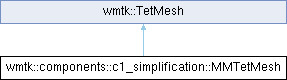
Inheritance diagram for wmtk::components::c1_simplification::MMTetMesh:
Classes | |
| struct | TetCollpaseInfoCache |
Public Types | |
| using | Tvattrs = wmtk::AttributeCollection< TetMeshVertexAttribute > |
 Public Types inherited from wmtk::TetMesh | |
| enum class | OpKind : int { split , collapse , swap_32 , swap_44 , swap_56 , swap_face , COUNT } |
| enum class | OpEvent : int { attempt , before_hook , link_condition , no_return_tet , duplicate_tet , topology , valence , boundary , exists , no_case_allowed , no_better_case , out_of_slots , after_hook , invariants , committed , screened , COUNT } |
| template<typename T > | |
| using | vector = std::vector< T > |
| using | VertexMutex = wmtk::threading::VertexMutex |
Public Member Functions | |
| void | init_from_eigen (const MatrixXd &V, const MatrixXi &T) |
| bool | is_inverted (const Tuple &t) const |
| bool | collapse_edge_before (const Tuple &t) override |
| User specified preparations and desideratas for an edge collapse before changing the connectivity. | |
| bool | collapse_edge_after (const Tuple &t) override |
| User specified modifications and desideratas for after an edge collapse. | |
| Public Member Functions inherited from wmtk::TetMesh | |
| size_t | vert_capacity () const |
| get the current largest global vid | |
| size_t | tet_capacity () const |
| get the current largest global tid | |
| size_t | vertex_size () const |
| get the number of unremoved verticies | |
| size_t | tet_size () const |
| get the number of unremoved tets | |
| void | init (size_t n_vertices, const std::vector< std::array< size_t, 4 > > &tets) |
| void | init_with_isolated_vertices (size_t n_vertices, const std::vector< std::array< size_t, 4 > > &tets) |
| void | init (const MatrixXi &T) |
| Generate the connectivity of the mesh from an IGL-style T matrix. | |
| bool | split_edge (const Tuple &t, std::vector< Tuple > &new_tets) |
| virtual bool | collapse_edge (const Tuple &t, std::vector< Tuple > &new_tets) |
| bool | link_condition (const Tuple &t) |
| bool | collapse_edge_conn (const Tuple &loc0, size_t &v1_id, Tuple &new_loc, std::map< size_t, wmtk::TetMesh::VertexConnectivity > &rollback_vert_conn, std::vector< size_t > &n1_t_ids_copy, std::vector< size_t > &new_tet_id, std::vector< TetrahedronConnectivity > &old_tets) |
| bool | collapse_edge_check_topology (const std::vector< size_t > &new_tet_id) |
| Check topology after collapse connectivity change. This is a sanity check and should not be necessary. | |
| void | collapse_edge_rollback (size_t &v1_id, std::map< size_t, wmtk::TetMesh::VertexConnectivity > &rollback_vert_conn, std::vector< size_t > &n1_t_ids, std::vector< size_t > &new_tet_id, std::vector< TetrahedronConnectivity > &old_tets) |
| bool | swap_edge_56 (const Tuple &t, std::vector< Tuple > &new_tets) |
| bool | swap_edge_44 (const Tuple &t, std::vector< Tuple > &new_tets) |
| bool | swap_edge (const Tuple &t, std::vector< Tuple > &new_tets) |
| 3-2 edge swap | |
| bool | swap_face (const Tuple &t, std::vector< Tuple > &new_tets) |
| 2-3 face swap | |
| bool | smooth_vertex (const Tuple &t) |
| bool | split_tet (const Tuple &t, std::vector< Tuple > &new_tets) |
| Split a tet in 4 tets. | |
| bool | split_face (const Tuple &t, std::vector< Tuple > &new_tets) |
| Split a face in 3 faces. | |
| void | triangle_insertion (const std::vector< Tuple > &intersected_tets, const std::vector< Tuple > &intersected_edges, std::vector< size_t > &new_edge_vids, std::vector< size_t > &new_center_vids, std::vector< std::array< size_t, 4 > > ¢er_split_tets) |
| Insert a triangle into a tetmesh, with known intersection information. | |
| bool | insert_point (const Tuple &t, std::vector< Tuple > &new_tets) |
| Insert a point into a tetmesh inside a tet. In general position, this split a tet into 4. In face position, split two tets. In edge position, In point position, do nothing. It has no surface history hooks, and throws while a surface history is recording. | |
| virtual bool | insert_point_before (const Tuple &t) |
| virtual bool | insert_point_after (std::vector< Tuple > &new_tets) |
| void | consolidate_mesh () |
| cleans up the deleted vertices or tetrahedra, fixes the corresponding indices, and reset the version number. WARNING: it invalidates all tuples! | |
| std::shared_ptr< history::TrackedSurfaceRecorder > | start_surface_history (std::function< Eigen::Vector3d(size_t)> position) |
| Record every change to the tracked surface from now on (see wmtk/history/TrackedRecorder.hpp). | |
| void | stop_surface_history () |
| Stop recording. The recorder keeps what it has. | |
| size_t | resync_surface_history () |
| std::shared_ptr< history::VolumeRecorder > | start_volume_history (std::function< Eigen::Vector3d(size_t)> position) |
Record, alongside the surface history, the tets around every operation that changes the tracked surface (wmtk/history/VolumeHistory.hpp): what a map of the volume needs. The surface history must be recording; a volume history is its own choice, since it takes far more room. position(v) is called as start_surface_history()'s is; a tet's region is its tet_tags(). | |
| void | stop_volume_history () |
| Stop recording the volume. The recorder keeps what it has. | |
| virtual std::vector< int64_t > | tet_tags (size_t tid) const |
| std::vector< std::array< size_t, 3 > > | tracked_faces () const |
| Every tracked face, oriented by orient_tracked_face(). | |
| virtual bool | is_tracked_face (size_t tid, int j) const |
| virtual std::vector< std::array< size_t, 2 > > | tracked_feature_edges () const |
| virtual std::array< size_t, 3 > | orient_tracked_face (const std::array< size_t, 3 > &f, const std::vector< size_t > &tets) const |
| std::array< size_t, 3 > | orient_tracked_face (const std::array< size_t, 3 > &f) const |
| orient_tracked_face, finding the face's tets. | |
| std::array< size_t, 3 > | face_out_of (size_t tid, const std::array< size_t, 3 > &face) const |
The corners of face, a face of tet tid, ordered so that its normal points out of the tet – for a tet the right way round as TetOptimizerMesh has them, with its fourth vertex on the side of the first three's normal (orient3d negative). | |
| std::vector< size_t > | tets_of_face (const std::array< size_t, 3 > &f) const |
The tets with the face f, sorted: one on the boundary, two inside. | |
| std::vector< Tuple > | get_edges () const |
| std::vector< Tuple > | get_faces () const |
| std::vector< Tuple > | get_vertices () const |
| std::vector< Tuple > | get_tets () const |
| virtual void | for_each_face (const std::function< void(const TetMesh::Tuple &)> &) |
| looping through all the unique edges and perform the given function | |
| void | set_preallocation_factor (double factor) |
| Preallocation factor: init/consolidate reserve capacity = max(floor, ceil(factor * live_count)) so operations can grab fresh slots without resizing the storage. When a pass exhausts the reserved capacity the affected operations fail (and are retried later after a consolidate). Tune per application (e.g. from JSON); values < 1 are clamped to 1. | |
| double | preallocation_factor () const |
| bool | slots_exhausted () const |
| void | clear_slots_exhausted () |
| size_t | request_tet_slots (size_t n) |
| size_t | request_vert_slots (size_t n) |
| void | ensure_free_tet_capacity (size_t extra) |
| void | ensure_free_vert_capacity (size_t extra) |
| virtual bool | invariants (const std::vector< Tuple > &) |
| virtual void | op_event (OpKind, OpEvent) const |
| bool | op_refused (const OpKind k, const OpEvent e) const |
op_event() for a refusal, returning false so a site reads return op_refused(...). | |
| bool | op_screened (const OpKind k) const |
| The end of a dry run that would have gone on to change the mesh: true, and counted. | |
| Tuple | tuple_from_edge (size_t tid, int local_eid) const |
| get a Tuple from global tetra index and local edge index (from 0-5). | |
| Tuple | tuple_from_edge (const std::array< size_t, 2 > &vids) const |
| get a Tuple from global vids of the 2 end of an edge | |
| Tuple | tuple_from_face (size_t tid, int local_fid) const |
| get a Tuple from global tetra index and local face index (from 0-3). | |
| std::tuple< Tuple, size_t > | tuple_from_face (const std::array< size_t, 3 > &vids) const |
| get a Tuple and the global face index from global vertex index of the face. | |
| std::optional< std::tuple< Tuple, size_t > > | try_tuple_from_face (const std::array< size_t, 3 > &vids) const |
| tuple_from_face for callers where a missing face is an answer, not a bug. | |
| size_t | lowest_common_tet (size_t v0_id, size_t v1_id, size_t v2_id) const |
| Lowest tet id incident to all three vertices, or size_t(-1) if there is none. | |
| size_t | vertex_valence (const size_t vid) const |
| Number of tets incident to a vertex, in O(1). | |
| std::tuple< Tuple, size_t > | tuple_from_face (const simplex::Face &f) const |
| Tuple | tuple_from_vertex (size_t vid) const |
| get a Tuple from global vertex index | |
| Tuple | tuple_from_tet (size_t tid) const |
| get a Tuple from global tetra index | |
| Tuple | tuple_from_vids (size_t vid0, size_t vid1, size_t vid2, size_t vid3) const |
| Get a Tuple from global vertex IDs. | |
| simplex::Tet | simplex_from_tet (const Tuple &t) const |
| simplex::Tet | simplex_from_tet (const size_t tid) const |
| simplex::Face | simplex_from_face (const Tuple &t) const |
| simplex::Edge | simplex_from_edge (const Tuple &t) const |
| Tuple | switch_vertex (const Tuple &t) const |
| wrapper function from Tuple::switch_vertex | |
| Tuple | switch_edge (const Tuple &t) const |
| wrapper function from Tuple::switch_edge | |
| Tuple | switch_face (const Tuple &t) const |
| wrapper function from Tuple::switch_face | |
| std::optional< Tuple > | switch_tetrahedron (const Tuple &t) const |
| wrapper function from Tuple::switch_tetrahedron | |
| std::vector< Tuple > | get_one_ring_tets_for_vertex (const Tuple &t) const |
| Get the one ring tets for a vertex. | |
| const std::vector< size_t > & | get_one_ring_tids_for_vertex (const Tuple &t) const |
| Get the one ring tids for vertex. | |
| const std::vector< size_t > & | get_one_ring_tids_for_vertex (const size_t vid) const |
| std::vector< Tuple > | get_one_ring_vertices_for_vertex (const Tuple &t) const |
| Get the one ring vertices for a vertex. | |
| std::vector< size_t > | get_one_ring_vids_for_vertex (size_t vid, std::vector< size_t > &cache) |
| Get the one ring vids for vertex. | |
| std::vector< size_t > | get_one_ring_vids_for_vertex (size_t vid) const |
| Get the one ring vids for vertex. | |
| std::vector< size_t > | get_one_ring_vids_for_vertex_adj (size_t vid) const |
| Duplicate of the function TetMesh::get_one_ring_vids_for_vertex. | |
| std::vector< size_t > | get_one_ring_vids_for_vertex_adj (size_t vid, std::vector< size_t > &cache) |
| Duplicate of the function TetMesh::get_one_ring_vids_for_vertex. | |
| std::vector< Tuple > | get_incident_tets_for_edge (const Tuple &t) const |
| Get the incident tets for edge. | |
| std::vector< Tuple > | get_incident_tets_for_edge (const size_t vid0, const size_t vid1) const |
| std::vector< size_t > | get_incident_tids_for_edge (const Tuple &t) const |
| std::vector< size_t > | get_incident_tids_for_edge (const size_t vid0, const size_t vid1) const |
| std::vector< Tuple > | get_one_ring_tets_for_edge (const Tuple &t) const |
| Get the one ring tets for edge. | |
| std::vector< std::array< size_t, 3 > > | vertex_adjacent_boundary_faces (const Tuple &t) const |
| std::array< Tuple, 4 > | oriented_tet_vertices (const Tuple &t) const |
| std::array< size_t, 4 > | oriented_tet_vids (const Tuple &t) const |
| std::array< size_t, 4 > | oriented_tet_vids (const size_t tid) const |
| std::array< Tuple, 3 > | get_face_vertices (const Tuple &t) const |
| Get the 3 vertices of a face represented by Tuple. | |
| std::array< size_t, 3 > | get_face_vids (const Tuple &t) const |
| std::array< Tuple, 6 > | tet_edges (const Tuple &t) const |
| get the 6 edges of a tet represented by Tuples | |
| void | check_tuple_validity (const Tuple &t) const |
| bool | check_mesh_connectivity_validity () const |
| checks the validity of the connectivity of the mesh. Including the validity of each Tuple | |
| void | remove_tets_by_ids (const std::vector< size_t > &tids) |
| remove the tetrahedrons in the mesh that have given tet ids | |
| void | start_protect_attributes () |
| void | release_protect_attributes () |
| void | rollback_protected_attributes () |
| int | release_vertex_mutex_in_stack () |
| int | release_vertex_mutex_to (size_t mark) |
Release the mutexes taken since the release stack held mark entries. | |
| bool | try_set_vertex_mutex_n_ring (const Tuple &v, int threadid, int n) |
Lock every vertex within graph distance n of v, the seed included. | |
| bool | try_set_vertex_mutex_n_ring (size_t vid, int threadid, int n) |
| bool | try_set_edge_mutex_n_ring (const Tuple &e, int threadid, int n) |
| try_set_vertex_mutex_n_ring seeded from both ends of an edge. | |
| bool | try_set_face_mutex_n_ring (size_t v1, size_t v2, size_t v3, int threadid, int n) |
| try_set_vertex_mutex_n_ring seeded from the three vertices of a face. | |
| void | for_each_edge (const std::function< void(const TetMesh::Tuple &)> &) |
| perform the given function for each edge | |
| void | for_each_vertex (const std::function< void(const TetMesh::Tuple &)> &) |
| perform the given function for each vertex | |
| void | for_each_tetra (const std::function< void(const TetMesh::Tuple &)> &) |
| perform the given function for each tet | |
| virtual bool | vertex_is_on_surface (const size_t vid) const |
| Is a vertex part of the substructure. | |
| virtual bool | face_is_on_surface (const size_t fid) const |
| Is a face part of the substructure. | |
| simplex::SimplexCollection | get_surface_faces_for_vertex (const size_t vid) const |
| Get all faces on the surface that are incident to vid. | |
| simplex::SimplexCollection | get_surface_faces_for_edge (const std::array< size_t, 2 > &vids) const |
| Get all faces on the surface that are incident to the edge. | |
| size_t | get_num_surface_faces_for_edge (const std::array< size_t, 2 > &vids) const |
| Get the number of surface faces incident to the edge. | |
| size_t | compute_vertex_order (const size_t vid) const |
| Compute the vertex order for a single vertex. | |
| virtual size_t | get_order_of_vertex (const size_t vid) const |
| Get the order of a vertex. | |
| size_t | get_order_of_edge (const std::array< size_t, 2 > &vids) const |
| Compute the order of an edge. | |
| virtual size_t | substructure_order_of_edge (const std::array< size_t, 2 > &vids) const |
| The orders substructure_link_condition consults, overridable so an application can widen the 1D substructure beyond what the surface complex derives. | |
| virtual size_t | substructure_order_of_vertex (const size_t vid) const |
| virtual void | substructure_feature_neighbors (size_t, std::vector< size_t > &) const |
One-ring vertices x of vid where (vid, x) is 1D substructure NOT derivable from the surface complex (feature edges through the interior, for instance). The link condition's order-2 edge collection walks surface faces and would never see them. | |
| bool | substructure_link_condition (const Tuple &e_tuple) const |
| Link condition that also considers substructures. | |
| size_t | tet_storage_capacity () const |
| size_t | vert_storage_capacity () const |
| bool | try_set_vertex_mutex_two_ring (const Tuple &v, int threadid) |
| Lock v's one-ring and, partially, its two-ring. See the note above. | |
| bool | try_set_vertex_mutex_two_ring_vid (const Tuple &v, int threadid) |
| try_set_vertex_mutex_two_ring reached through vids rather than Tuples. | |
| bool | try_set_vertex_mutex_two_ring_vid (size_t v, int threadid) |
| try_set_vertex_mutex_two_ring reached through vids rather than Tuples. | |
| bool | try_set_edge_mutex_two_ring (const Tuple &e, int threadid=0) |
| Lock the edge's one-ring and, partially, its two-ring. See the note above. | |
| bool | try_set_face_mutex_two_ring (const Tuple &f, int threadid=0) |
| Lock the face's one-ring and, partially, its two-ring. See the note above. | |
| bool | try_set_face_mutex_two_ring (const Tuple &v1, const Tuple &v2, const Tuple &v3, int threadid=0) |
| Lock the face's one-ring and, partially, its two-ring. See the note above. | |
| bool | try_set_face_mutex_two_ring (size_t v1, size_t v2, size_t v3, int threadid=0) |
| Lock the face's one-ring and, partially, its two-ring. See the note above. | |
| bool | try_set_vertex_mutex_one_ring (const Tuple &v, int threadid=0) |
| Lock v and its one-ring. Complete, unlike the two-ring family. | |
| size_t | cell_capacity () const |
| size_t | cell_storage_capacity () const |
| Tuple | tuple_from_cell (size_t cid) const |
| size_t | cell_slot_bound (const Tuple &t) const |
| void | reserve_free_slots (size_t cells, size_t verts) |
| virtual bool | storage_grows_on_demand () const |
Public Attributes | |
| TetCollpaseInfoCache | t_cache |
| Tvattrs | v_attrs |
| Public Attributes inherited from wmtk::TetMesh | |
| bool | m_check_smoothing_stays_in_star = false |
| While true, smooth_vertex() checks that the smooth recorded nothing outside the vertex's star – the vertex itself and the edges, faces and cells incident to it – and throws if it did. | |
| AbstractAttributeContainer * | p_vertex_attrs = nullptr |
| AbstractAttributeContainer * | p_edge_attrs = nullptr |
| AbstractAttributeContainer * | p_face_attrs = nullptr |
| AbstractAttributeContainer * | p_tet_attrs = nullptr |
| bool | m_collapse_check_link_condition = true |
| bool | m_collapse_check_topology = false |
| bool | m_collapse_check_manifold = true |
| wmtk::threading::enumerable_thread_specific< std::vector< size_t > > | mutex_release_stack |
| wmtk::threading::enumerable_thread_specific< std::vector< size_t > > | get_one_ring_cache |
| int | NUM_THREADS = 0 |
Additional Inherited Members | |
| Static Public Member Functions inherited from wmtk::TetMesh | |
| static bool | dry_run () |
| Whether operations on this thread are dry runs (see wmtk/OperationDryRun.hpp). | |
| static SlotUsage | slot_usage_of_this_thread () |
| Static Public Attributes inherited from wmtk::TetMesh | |
| static constexpr int | EDGES_PER_CELL = 6 |
| static constexpr int | FACES_PER_CELL = 4 |
| Protected Member Functions inherited from wmtk::TetMesh | |
| std::vector< std::array< size_t, 3 > > | tracked_faces_around (const std::vector< size_t > &vs, bool all) const |
| std::vector< VertexFace > | faces_at_vertex (size_t v) const |
| The faces with v as a corner, found from v's tets alone. | |
| size_t | face_id_in (const std::array< size_t, 3 > &f, size_t tid) const |
| The face id (Tuple::fid) of f, a face of tet tid, its lowest; from tid alone. | |
| virtual bool | checks_tracked_surface () const |
| Checks an application makes on what an operation does to the tracked surface. | |
| virtual void | tracked_surface_before (const std::vector< size_t > &vs, bool all) |
| virtual bool | tracked_surface_after (const std::vector< size_t > &vs, bool all) |
| virtual void | on_slot_storage_grown () |
| virtual bool | triangle_insertion_before (const std::vector< Tuple > &faces) |
| virtual bool | triangle_insertion_after (const std::vector< std::vector< Tuple > > &) |
| virtual bool | split_edge_before (const Tuple &t) |
| User specified preparations and desideratas for an edge split before changing the connectivity. | |
| virtual bool | split_edge_after (const Tuple &t) |
| This function computes the attributes for the added simplices. User specified modifications and desideratas for after an edge split. | |
| virtual bool | swap_edge_44_before (const Tuple &t) |
| User specified preparations and desideratas for an 4-4 edge swap before changing the connectivity. | |
| virtual double | swap_edge_44_energy (const std::vector< std::array< size_t, 4 > > &tets, const int op_case) |
| User specified energy to decide which of the 4 possible orientations should be chosen. | |
| virtual bool | swap_edge_44_after (const Tuple &t) |
| User specified modifications and desideratas for after a 4-4 edge swap. | |
| virtual bool | swap_edge_44_accept_case (const std::array< size_t, 2 > &new_edge) |
| Filter which of the 4-4 orientations may be chosen. | |
| virtual bool | swap_edge_56_before (const Tuple &t) |
| User specified preparations and desideratas for a 5-6 edge swap before changing the connectivity. | |
| virtual double | swap_edge_56_energy (const std::vector< std::array< size_t, 4 > > &tets, const int op_case) |
| User specified energy to decide which of the 5 possible orientations should be chosen. | |
| virtual bool | swap_edge_56_after (const Tuple &t) |
| User specified modifications and desideratas for after a 5-6 edge swap. | |
| virtual bool | swap_edge_56_accept_case (const std::array< size_t, 3 > &new_face) |
| Filter which of the 5-6 orientations may be chosen. | |
| virtual bool | swap_edge_before (const Tuple &t) |
| User specified preparations and desideratas for an 3-2 edge swap before changing the conenctivity. | |
| virtual bool | swap_edge_after (const Tuple &t) |
| User specified modifications and desideratas for after a 3-2 edge swap. | |
| virtual bool | swap_face_before (const Tuple &t) |
| User specified preparations and desideratas for an 2-3 face swap befroe changing the geometry. | |
| virtual bool | swap_face_after (const Tuple &t) |
| User specified modifications and desideratas for after a 2-3 face swap. | |
| virtual bool | smooth_before (const Tuple &t) |
| User specified preparations and desideratas for smoothing a vertex. | |
| virtual bool | smooth_after (const Tuple &t) |
| User specified modifications and desideratas for after smoothing a vertex. | |
| virtual bool | split_face_before (const Tuple &t) |
| User specified preparations and desideratas for a face split before changing the connectivity. | |
| virtual bool | split_face_after (const Tuple &t) |
| Compute the attributes for the added simplices. | |
| virtual bool | split_tet_before (const Tuple &t) |
| User specified preparations and desideratas for a tet split before changing the connectivity. | |
| virtual bool | split_tet_after (const Tuple &t) |
| Compute the attributes for the added simplices. | |
| void | resize_vertex_mutex (size_t v) |
| Static Protected Attributes inherited from wmtk::TetMesh | |
| static constexpr std::array< std::array< int, 2 >, 6 > | m_local_edges |
| local edges within a tet | |
Member Function Documentation
◆ collapse_edge_after()
|
overridevirtual |
User specified modifications and desideratas for after an edge collapse.
- Parameters
-
t edge Tuple that's collapsed
- Returns
- true if the modification succeed
Reimplemented from wmtk::TetMesh.
◆ collapse_edge_before()
|
overridevirtual |
User specified preparations and desideratas for an edge collapse before changing the connectivity.
- Parameters
-
t edge Tuple to be collapsed
- Returns
- true is the preparation succeed
Reimplemented from wmtk::TetMesh.
The documentation for this class was generated from the following files:
- components/c1_simplification/wmtk/components/c1_simplification/c1_multimesh.hpp
- components/c1_simplification/wmtk/components/c1_simplification/c1_multimesh.cpp