THE offset term of a front vertex's smoothing objective: the mean squared relative error of the field over the stencil of each incident offset face. More...
#include <OffsetPotential.hpp>
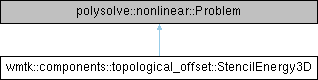
Classes | |
| struct | Face |
| One incident offset face, the moving vertex implicit. More... | |
| struct | Sample |
One stencil point's barycentric weights. a is the moving vertex's, so dq_i/dx = a_i I. More... | |
Public Member Functions | |
| StencilEnergy3D (const std::shared_ptr< const OffsetPotential3D > &potential, std::vector< Face > faces, double weight) | |
| double | value (const TVector &x) override |
| void | gradient (const TVector &x, TVector &gradv) override |
| void | hessian (const TVector &x, THessian &hessian) override |
| void | hessian (const TVector &x, MatrixXd &hessian) override |
| void | solution_changed (const TVector &new_x) override |
Private Member Functions | |
| bool | residual_at (const Eigen::Vector3d &p, double &r, Eigen::Vector3d *dr) const |
Private Attributes | |
| std::shared_ptr< const OffsetPotential3D > | m_potential |
| std::vector< Face > | m_faces |
| double | m_weight |
| double | m_c = 1. |
| the potential's target level, cached | |
Detailed Description
THE offset term of a front vertex's smoothing objective: the mean squared relative error of the field over the stencil of each incident offset face.
E(x) = w * sum over the vertex's incident offset faces f of
           (1/N_s) * sum over f's N_s stencil points i of  r(q_i(x))^2

r(p) = (Phi(p) - c) / c,      q_i(x) = a_i x + b_i q1 + c_i q2
with c the target level and (a_i, b_i, c_i) the barycentric weights of stencil point i, a_i being the MOVING vertex's own weight. The face's other two corners q1, q2 are fixed for the visit. The stencil is TopoOffsetTetMesh::for_each_face_sample, sized by stencil_order.
THIS ONE TERM REPLACES BOTH the placement term (OffsetEnergy3D on the vertex alone) and the sag term (SagEnergy3D over the face interiors) that preceded it, because the stencil contains the corners: at order 0 the stencil IS the three corners, so E is exactly the placement residual of the vertex and its neighbours, and every higher order adds interior points that ask the same question between them. There is nothing left for a separate sag measure to say.
r IS THE PLAIN RELATIVE ERROR (Phi - c)/c, which for the euclidean field is exactly (d - target_distance)/target_distance – the same residual OffsetEnergy3D uses there. For the SMOOTH field OffsetEnergy3D instead divides by g_ref * delta to get a monotone length; this class does not, so under offset_field: "smooth" the two are scaled differently. Euclidean is the default and the only field these runs use.
NOTE THE PER-FACE MEAN, SUMMED OVER FACES, with no area weighting: a vertex with V incident faces contributes its own r(x)^2 with coefficient V/N_s, since it is a stencil point of every one of them. The energy therefore grows with valence, which the AMIPS term beside it does too.
The derivatives are exact and the Hessian is Gauss-Newton, which here is also PSD by construction (a sum of a_i^2 dr dr^T outer products), so no eigenvalue projection is needed – unlike the L1 sag term this replaces, whose Hessian was indefinite. LineProblem3D takes n^T H n, so the 1-D normal solve inherits that.
Member Function Documentation
◆ residual_at()
|
private |
r and, optionally, dr at p. false when Phi or its gradient is not finite there, in which case the sample is dropped exactly as the criterion drops it.
The documentation for this class was generated from the following files:
- /home/runner/work/wildmeshing-toolkit/wildmeshing-toolkit/components/topological_offset/wmtk/components/topological_offset/OffsetPotential.hpp
- /home/runner/work/wildmeshing-toolkit/wildmeshing-toolkit/components/topological_offset/wmtk/components/topological_offset/OffsetPotential.cpp