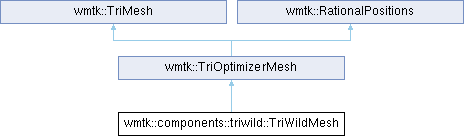
Public Member Functions | |
| std::shared_ptr< Envelope > | surface_envelope_for_edge (const std::array< size_t, 2 > &vids, const EdgeAttributes &attr) const override |
| std::shared_ptr< Envelope > | smoothing_energy_envelope (const size_t vid) const override |
| TriWildMesh (Parameters &_m_params, double envelope_eps, int _num_threads=0) | |
| void | init_mesh (const MatrixXd &V, const std::vector< Vector2r > &V_rational, const MatrixXi &F, const MatrixXi &E, const std::vector< std::string > &tag_names, const MatrixXd &V_env, const MatrixXi &E_env, const std::vector< int > *E_orientation=nullptr, const std::vector< size_t > &free_point_vids={}, const std::vector< int > *E_env_input=nullptr, const std::vector< InputSet > *E_input_set=nullptr) |
| Init mesh from IGL-style matrices. | |
| void | init_surfaces_and_boundaries () |
| void | init_envelope (const MatrixXd &V, const MatrixXi &F) |
| size_t | refine_sizing_around_worst (double max_energy) override |
| The old global sizing-field update (KNN R-ball around every low-quality triangle). Superseded by refine_sizing_around_worst, but kept compiled and callable so the two can be compared – tetwild and simwild keep theirs for the same reason. | |
| void | write_vtu (const std::string &path, MeshMap *output=nullptr) const |
| void | compute_winding_numbers (const std::vector< MatrixXd > &Vs, const std::vector< MatrixXi > &Es) |
| Tag every face with the inputs it lies inside, by winding number. | |
| void | filter_with_input_winding_number () |
| Remove the faces that lie inside no input (needs compute_winding_numbers). | |
| void | compute_tracked_winding_number () |
| Winding number of every face's centroid w.r.t. the tracked curves, oriented as the input was (m_tracks_orientation must be set), into FaceAttributes::m_winding_number. | |
| void | filter_with_tracked_winding_number () |
| Remove the faces whose tracked winding number is at most 1/2. | |
| void | filter_with_flood_fill () |
| Remove the flood-fill region that dominates the mesh boundary (needs flood_fill). | |
| int | flood_fill () |
 Public Member Functions inherited from wmtk::TriOptimizerMesh | |
| std::vector< std::array< size_t, 2 > > | oriented_tracked_edges () const |
| std::vector< std::pair< size_t, int > > | tracked_curve_boundary () const |
| Vertices where the oriented tracked curves have a boundary (in minus out != 0), each with that sum. Empty for closed input curves; the operations preserve it. | |
| TriOptimizerMesh (OptimizerParameters ¶ms) | |
| size_t | get_partition_id (const Tuple &loc) const |
| void | partition_mesh () |
| void | partition_mesh_morton () |
| double | get_length2 (const Tuple &l) const |
| bool | is_inverted (const std::array< size_t, 3 > &vs) const |
| Orientation check, exact for the coordinates the vertices actually carry. | |
| bool | is_inverted (const Tuple &loc) const |
| bool | is_inverted (const size_t fid) const |
| bool | is_inverted_f (const Tuple &loc) const |
| Inversion check using only the double positions. | |
| bool | is_inverted_f (const size_t fid) const |
| double | get_quality (const std::array< size_t, 3 > &vs) const |
| double | get_quality (const Tuple &loc) const |
| double | get_quality (const size_t fid) const |
| std::tuple< double, double > | get_max_avg_energy () |
| virtual void | update_attributes () |
| Update the attributes of the mesh after an iteration of operations. | |
| void | mesh_improvement (int max_its=80) |
| std::tuple< double, double > | local_operations (const std::array< int, 4 > &ops, bool collapse_limit_length=true) |
| bool | storage_grows_on_demand () const override |
| bool | split_edge_is_due (const Tuple &e) const |
| bool | is_force_split_edge (const size_t v1, const size_t v2) const |
| void | split_all_edges () |
| bool | split_edge_before (const Tuple &t) override |
| User specified preparations and desideratas for an edge split. | |
| bool | split_edge_after (const Tuple &loc) override |
| User specified modifications and desideratas after an edge split. | |
| void | collapse_all_edges (bool is_limit_length=true) |
| bool | collapse_edge_before (const Tuple &t) override |
| User specified preparations and desideratas for an edge collapse including the link check as collapse prerequisite. | |
| bool | collapse_edge_after (const Tuple &t) override |
| User specified modifications and desideratas after an edge collapse. | |
| size_t | coarsen_mesh () |
| Coarsen the mesh without letting the max energy rise. | |
| bool | coarsen_collapse_edge (const Tuple &e, std::vector< Tuple > &new_tris) |
| One collapse under the coarsening rules, outside a coarsening pass. | |
| size_t | swap_all_edges () |
| Run TriWild's quality-improving interior edge-flip pass. | |
| double | swap_weight (const Tuple &t) const |
| bool | swap_edge_before (const Tuple &t) override |
| User specified preparations and desideratas for an edge swap including 1.can't swap on boundary edge. 2. when swap edge between v1, v2, there can't exist edges between the two opposite vertices v3, v4. | |
| bool | swap_edge_after (const Tuple &t) override |
| User specified modifications and desideras after an edge swap. | |
| void | smooth_all_vertices (size_t n_iters=1) |
| Run TriWild's vertex-smoothing pass. | |
| bool | use_colored_smoothing () const |
| Whether this pass smooths by color class (see OptimizerParameters::colored_smoothing). | |
| void | smooth_vertices_colored (const std::vector< std::pair< std::string, Tuple > > &ops) |
One smoothing sweep over ops (all "vertex_smooth"), one color class at a time. | |
| bool | smooth_before (const Tuple &t) override |
The smoothing hooks. A derived class overriding them – or invariants(), which a smooth also runs – must read every attribute outside the smoothed vertex's star (other vertices, and the edges and triangles not incident to the vertex) through const access, e.g. std::as_const(m_vertex_attribute)[u]. | |
| bool | smooth_after (const Tuple &t) override |
| User specified modifications and desideras after an edge smooth. | |
| Vector2d | smoothing_position (size_t vid) const |
| void | set_smoothing_position (size_t vid, const Vector2d &p) |
| virtual bool | smoothing_position_is_allowed (const size_t vid, const Vector2d &p) const |
| virtual std::shared_ptr< Envelope > | smoothing_containment_envelope (const size_t, const std::array< size_t, 2 > &edge, const EdgeAttributes &attr) const |
| virtual std::shared_ptr< polysolve::nonlinear::Problem > | smoothing_extra_energy (const size_t vid) const |
| An extra term the application adds to this vertex's smoothing objective, or null. | |
| virtual double | smoothing_cell_energy (const size_t, const double quality) const |
| The number the shared smoother compares for one face, given the face's quality at the position being tested: the projected step's candidate test and the quality veto take the max of this over the ring. The quality itself by default, so TriWild and SimWild compare exactly what they compared before. The 3D twin is TetOptimizerMesh::smoothing_cell_energy. | |
| double | active_quality_threshold () const |
| virtual std::vector< size_t > | active_vertices () const |
| virtual double | quality_rel (const size_t fid) const |
| A face's quality relative to the quality it is required to reach; <= 1 means it meets it. | |
| bool | round (const Tuple &v) |
| Round a vertex position to floating point, if that inverts no incident face. | |
| bool | is_edge_on_surface (const Tuple &loc) const |
| bool | is_tracked_edge (const Tuple &e) const override |
| std::vector< size_t > | tracked_feature_points () const override |
| void | record_curve_history (const std::string &metadata, const CurveSources &sources={}) |
| std::optional< history::CurveHistory > | finish_curve_history (const history::CurveHistory *input=nullptr) |
| Check the recorded curves against the tracked edges, stop recording, log what the history holds and return it, for the application to save (io::ComponentIO::save_history). None if not recording. | |
| bool | is_edge_on_surface (const std::array< size_t, 2 > &vids) const |
| bool | is_edge_on_bbox (const Tuple &loc) const |
| bool | is_edge_on_bbox (const std::array< size_t, 2 > &vids) const |
| bool | vertex_is_on_surface (const size_t vid) const override |
| Is a vertex part of the substructure. | |
| bool | edge_is_on_surface (const std::array< size_t, 2 > &vids) const override |
| Is an edge part of the substructure. | |
| bool | surface_segment_is_outside (const size_t a, const size_t b, const EdgeAttributes &attr) const |
| std::vector< std::array< size_t, 2 > > | get_edges_by_condition (std::function< bool(const EdgeAttributes &)> cond) const |
| void | gradation_smooth_sizing (double grade, const std::vector< size_t > &seeds) |
| Monotone (only-decreasing) gradation smoothing of the sizing field. | |
| void | throw_if_in_operation_pass (const char *call) const |
| void | enable_feature_point_tracking (const bool preserve) |
Turn on feature-point tracking, and the policy when preserve. | |
| bool | collapse_breaks_feature_point (const size_t v1_id, const size_t v2_id) const |
| bool | feature_point_ball_contains (const size_t vid, const Vector2d &p) const |
May vertex vid sit at p as far as its anchor goes? | |
| std::pair< size_t, size_t > | feature_retention (double *worst_ratio=nullptr) const |
| {feature points still represented within m_feature_eps, total feature points}. | |
| Public Member Functions inherited from wmtk::TriMesh | |
| void | init (size_t n_vertices, const std::vector< std::array< size_t, 3 > > &tris) |
| void | init (const MatrixXi &F) |
| Generate the connectivity of the mesh from an IGL-style F matrix. | |
| std::vector< Tuple > | get_vertices () const |
| std::vector< Tuple > | get_edges () const |
| std::vector< Tuple > | get_faces () const |
| Tuple | tuple_from_edge (size_t vid1, size_t vid2, size_t fid) const |
| Tuple | tuple_from_vids (size_t vid0, size_t vid1, size_t vid2) const |
| simplex::Vertex | simplex_from_vertex (const Tuple &t) const |
| simplex::Edge | simplex_from_edge (const Tuple &t) const |
| simplex::Face | simplex_from_face (const Tuple &t) const |
| simplex::Face | simplex_from_face (const size_t fid) const |
| Tuple | tuple_from_simplex (const simplex::Face &s) const |
| simplex::SimplexCollection | simplex_incident_triangles (const simplex::Vertex &v) const |
| simplex::SimplexCollection | simplex_incident_triangles (const simplex::Edge &e) const |
| simplex::SimplexCollection | simplex_link_vertices (const simplex::Vertex &v) const |
| simplex::SimplexCollection | simplex_link_vertices (const simplex::Edge &e) const |
| simplex::SimplexCollection | simplex_link_edges (const simplex::Vertex &v) const |
| void | set_preallocation_factor (double factor) |
| Preallocation factor: init/consolidate reserve capacity = max(floor, ceil(factor * live_count)) so operations can grab fresh slots without resizing the storage. When a pass exhausts the reserved capacity the affected operations fail (retried later after a consolidate). Values < 1 are clamped to 1. | |
| double | preallocation_factor () const |
| bool | slots_exhausted () const |
| void | clear_slots_exhausted () |
| size_t | request_tri_slots (size_t n) |
| size_t | request_vert_slots (size_t n) |
| virtual bool | invariants (const std::vector< Tuple > &) |
| User specified invariants that can't be violated. | |
| virtual bool | split_face_before (const Tuple &t) |
| User specified preparations and desideratas for a face split. | |
| virtual bool | split_face_after (const Tuple &t) |
| User specified modifications and desideratas after a face split. | |
| size_t | tri_capacity () const |
| get the current largest global fid | |
| size_t | vert_capacity () const |
| get the current largest global vid | |
| void | consolidate_mesh () |
| removing the elements that are removed | |
| std::shared_ptr< history::Recorder > | start_history (std::function< Eigen::Vector3d(size_t)> position) |
| Record every operation this mesh commits from now on (see wmtk/history). | |
| void | stop_history () |
| Stop recording. The recorder keeps the edits it has. | |
| std::shared_ptr< history::TrackedCurveRecorder > | start_curve_history (std::function< Eigen::Vector3d(size_t)> position) |
| Record every change to the tracked curves from now on (see wmtk/history/TrackedRecorder.hpp). | |
| void | stop_curve_history () |
| Stop recording curves. The recorder keeps what it has. | |
| size_t | resync_curve_history (const std::vector< std::array< size_t, 2 > > &edges) |
| std::vector< std::array< size_t, 2 > > | tracked_edges () const |
| Every tracked edge, each with its smaller vertex first. | |
| void | remove_tris_by_ids (const std::vector< size_t > &fids) |
| Mark the given triangles, and any vertex left without an incident triangle, as removed. | |
| Tuple | switch_vertex (const Tuple &t) const |
| a duplicate of Tuple::switch_vertex funciton | |
| Tuple | switch_edge (const Tuple &t) const |
| a duplicate of Tuple::switch_edge funciton | |
| std::optional< Tuple > | switch_face (const Tuple &t) const |
| a duplicate of Tuple::switch_face funciton | |
| bool | check_link_condition (const Tuple &t) const |
| prerequisite for collapse | |
| void | set_use_link_condition (bool use_it) |
| Should collapse_edge_before enforce the link condition? | |
| bool | use_link_condition () const |
| bool | check_mesh_connectivity_validity () const |
| verify the connectivity validity of the mesh | |
| bool | check_edge_manifold () const |
| verify the edge manifoldness of the mesh | |
| size_t | edge_valence (const TriMesh::Tuple &t) const |
| Number of triangles incident to the edge the Tuple points at. | |
| bool | is_boundary_edge (const TriMesh::Tuple &t) const |
| Does exactly one triangle share this edge? | |
| bool | is_manifold_edge (const TriMesh::Tuple &t) const |
| Do exactly two triangles share this edge? | |
| size_t | vertex_component_count (const size_t vid) const |
| Number of edge-connected components in the fan of a vertex. | |
| size_t | vertex_component_count (const TriMesh::Tuple &t) const |
| bool | is_manifold_vertex (const size_t vid) const |
| std::optional< Tuple > | switch_component (const TriMesh::Tuple &t) const |
| Jump to the next edge-connected component of the fan of the Tuple's vertex. | |
| bool | is_boundary_vertex (const TriMesh::Tuple &t) const |
| check if the vertex that's represented by a Tuple is at the boundary of the mesh | |
| bool | split_edge (const Tuple &t, std::vector< Tuple > &new_t) |
| virtual bool | collapse_edge (const Tuple &t, std::vector< Tuple > &new_t) |
| void | collapse_edge_conn (const Tuple &loc0, std::vector< Tuple > &new_tris, Tuple &return_t, size_t &new_vid, std::vector< std::pair< size_t, TriangleConnectivity > > &old_tris, std::vector< std::pair< size_t, VertexConnectivity > > &old_vertices, std::vector< std::pair< size_t, size_t > > &same_edge_vid_fid, std::vector< size_t > &n12_intersect_fids) |
| void | collapse_edge_rollback (size_t &new_vid, std::vector< std::pair< size_t, TriangleConnectivity > > &old_tris, std::vector< std::pair< size_t, VertexConnectivity > > &old_vertices, std::vector< std::pair< size_t, size_t > > &same_edge_vid_fid, std::vector< size_t > &n12_intersect_fids) |
| bool | swap_edge (const Tuple &t, std::vector< Tuple > &new_t) |
| bool | smooth_vertex (const Tuple &t) |
| bool | split_face (const Tuple &t, std::vector< Tuple > &new_t) |
| Split a face in 3 faces. | |
| size_t | get_valence_for_vertex (const Tuple &t) const |
| Count the number of the one ring tris for a vertex. | |
| size_t | vertex_valence (const size_t vid) const |
| Number of triangles incident to a vertex, by id. | |
| std::vector< Tuple > | get_one_ring_tris_for_vertex (const Tuple &t) const |
| Get the one ring tris for a vertex. | |
| const std::vector< size_t > & | get_one_ring_fids_for_vertex (const Tuple &t) const |
| const std::vector< size_t > & | get_one_ring_fids_for_vertex (const size_t vid) const |
| std::vector< size_t > | get_one_ring_vids_for_vertex_duplicate (const size_t &t) const |
| Get the vids of the incident one ring tris for a vertex. | |
| void | get_one_ring_vids_for_vertex_duplicate (const size_t &t, std::vector< size_t > &one_ring) const |
| std::vector< size_t > | get_incident_fids_for_edge (const Tuple &t) const |
| std::vector< size_t > | get_incident_fids_for_edge (const size_t vid0, const size_t vid1) const |
| std::vector< Tuple > | get_one_ring_edges_for_vertex (const Tuple &t) const |
Get all edges that are incident to the vertex of Tuple t. | |
| std::vector< Tuple > | get_one_ring_edges_for_vertex (const size_t vid) const |
| std::array< Tuple, 3 > | oriented_tri_vertices (const Tuple &t) const |
| Get the incident vertices for a triangle. | |
| std::array< size_t, 3 > | oriented_tri_vids (const Tuple &t) const |
| Get the incident vertices for a triangle. | |
| std::array< size_t, 3 > | oriented_tri_vids (const size_t i) const |
| std::array< Tuple, 2 > | get_edge_vertices (const Tuple &t) const |
| std::array< size_t, 2 > | get_edge_vids (const Tuple &t) const |
| Tuple | tuple_from_tri (size_t fid) const |
| Tuple | tuple_from_vertex (size_t vid) const |
| Tuple | tuple_from_edge (size_t fid, size_t local_eid) const |
| std::tuple< Tuple, size_t > | tuple_from_edge (const std::array< size_t, 2 > &vids) const |
| std::optional< std::tuple< Tuple, size_t > > | try_tuple_from_edge (const std::array< size_t, 2 > &vids) const |
| tuple_from_edge for callers where a missing edge is an answer, not a bug. | |
| void | start_protect_attributes () |
| Start the phase where the attributes that will be modified can be recorded. | |
| void | release_protect_attributes () |
| End the modification phase. | |
| void | rollback_protected_attributes () |
| rollback the attributes that are modified if any condition failed | |
| int | release_vertex_mutex_in_stack () |
| int | release_vertex_mutex_to (size_t mark) |
Release the mutexes taken since the release stack held mark entries. | |
| bool | try_set_vertex_mutex_n_ring (const Tuple &v, int threadid, int n) |
Lock every vertex within graph distance n of v, the seed included. | |
| bool | try_set_vertex_mutex_n_ring (size_t vid, int threadid, int n) |
| bool | try_set_edge_mutex_n_ring (const Tuple &e, int threadid, int n) |
| try_set_vertex_mutex_n_ring seeded from both ends of an edge. | |
| bool | try_set_face_mutex_one_ring (const Tuple &f, int threadid) |
| try lock the one-ring neighboring triangles' incident vertices. | |
| void | for_each_face (const std::function< void(const Tuple &)> &) |
| perform the given function for each face | |
| void | for_each_edge (const std::function< void(const Tuple &)> &) |
| perform the given function for each edge | |
| void | for_each_vertex (const std::function< void(const Tuple &)> &) |
| perform the given function for each vertex | |
| simplex::SimplexCollection | get_surface_edges_for_vertex (const size_t vid) const |
| Get all edges on the surface that are incident to vid. | |
| size_t | get_order_of_edge (const std::array< size_t, 2 > &vids) const |
| Compute the order of an edge. | |
| size_t | get_order_of_vertex (const size_t vid) const |
| Get the order of a vertex. | |
| bool | substructure_link_condition (const Tuple &e_tuple) const |
| Link condition that also considers substructures. | |
| size_t | tri_storage_capacity () const |
| size_t | vert_storage_capacity () const |
| bool | try_set_vertex_mutex_two_ring (const Tuple &v, int threadid) |
| Lock v's one-ring and, partially, its two-ring. See the note above. | |
| bool | try_set_edge_mutex_two_ring (const Tuple &e, int threadid) |
| Lock the edge's one-ring and, partially, its two-ring. See the note above. | |
| bool | try_set_vertex_mutex_one_ring (const Tuple &v, int threadid) |
| Lock v and its one-ring. Complete, unlike the two-ring pair. | |
| size_t | cell_capacity () const |
| size_t | cell_storage_capacity () const |
| Tuple | tuple_from_cell (size_t cid) const |
| size_t | cell_slot_bound (const Tuple &t) const |
| void | reserve_free_slots (size_t cells, size_t verts) |
| Public Member Functions inherited from wmtk::RationalPositions | |
| size_t | round_all_vertices () |
| Try to round every un-rounded vertex; returns the number reclaimed. | |
| bool | round_and_check_all_rounded () |
| Run the sweep, then report whether the mesh is now fully rounded. | |
Public Attributes | |
| Parameters & | m_tri_params |
| std::vector< Vector2d > | m_V_envelope |
| std::vector< Vector2i > | m_E_envelope |
| wmtk::InputEnvelopes | m_input_envelopes |
| One envelope per input curve file, when there are several: a tracked segment is held to those of its input set (EdgeAttributes::input_set()), m_envelope stays their union. The 2D twin of TetWildMesh::m_input_envelopes. | |
| bool | m_has_parts = false |
| Public Attributes inherited from wmtk::TriOptimizerMesh | |
| VertAttCol | m_vertex_attribute |
| EdgeAttCol | m_edge_attribute |
| bool | m_tracks_orientation = false |
| The application set EdgeAttributes::m_orientation at insertion, so the tracked curves carry the input's direction and the operations keep it. See TetOptimizerMesh::m_tracks_orientation; this is the same thing one dimension down. | |
| FaceAttCol | m_face_attribute |
| AttributeContainerGroup | m_vertex_attr_group |
| What p_vertex_attrs points at, so a derived class can register more. | |
| AttributeContainerGroup | m_edge_attr_group |
| What p_edge_attrs points at, so a derived class can register more. | |
| AttributeContainerGroup | m_face_attr_group |
| What p_face_attrs points at, so a derived class can register more. | |
| OptimizerParameters & | m_params |
| std::shared_ptr< Envelope > | m_envelope |
| double | m_envelope_eps = -1 |
| double | m_s_amips = -1 |
| double | m_s_envelope = -1 |
| wmtk::threading::enumerable_thread_specific< std::unique_ptr< polysolve::nonlinear::Solver > > | m_solver |
| optimization::SmoothRejectCounters | m_smooth_rejects |
| Why smoothing attempts were refused, reported once per pass. | |
| bool | m_collapse_limit_length = true |
| int | m_debug_print_counter = 0 |
| std::string | m_debug_pass_name |
| size_t | m_tags_count = 0 |
| std::map< int64_t, std::string > | m_tag_id_to_name |
| std::map< std::string, int64_t > | m_tag_name_to_id |
| int | m_iterations_used = 0 |
| Shared TriWild/SimWild outer optimization schedule. | |
| std::set< simplex::Edge > | m_force_split_edges |
| size_t | m_force_split_count = 0 |
| std::unique_ptr< std::atomic< int >[]> | m_high_valence_claim |
| size_t | m_high_valence_claim_size = 0 |
| std::atomic< size_t > | m_high_valence_rejects = 0 |
| size_t | m_split_order_waits = 0 |
| The current split pass's ExecutePass::waits() and wait_defects(). | |
| size_t | m_split_order_wait_defects = 0 |
| CoarsenStats | m_coarsen_stats |
| FeaturePointAttCol | m_feature_point_attribute |
| Registered with m_vertex_attr_group only once enable_feature_point_tracking() ran. | |
| std::vector< Vector2d > | m_feature_points |
| double | m_feature_eps = -1 |
| bool | m_track_feature_points = false |
| Whether the shared operations maintain the ids (enable_feature_point_tracking()). | |
| bool | m_preserve_feature_points = false |
Whether the collapse and smoothing policy is on (its preserve argument). | |
| std::atomic< size_t > | m_feature_rejects = 0 |
| bool | m_in_operation_pass = false |
| True while a pass of the shared operations runs. | |
| Public Attributes inherited from wmtk::TriMesh | |
| AbstractAttributeContainer * | p_vertex_attrs = nullptr |
| AbstractAttributeContainer * | p_edge_attrs = nullptr |
| AbstractAttributeContainer * | p_face_attrs = nullptr |
| bool | m_check_smoothing_stays_in_star = false |
| While true, smooth_vertex() checks that the smooth recorded nothing outside the vertex's star – the vertex itself and the edges, faces and triangles incident to it – and throws if it did. | |
| wmtk::threading::enumerable_thread_specific< std::vector< size_t > > | mutex_release_stack |
| int | NUM_THREADS = 0 |
Protected Member Functions | |
| void | write_smoothing_debug_output (const std::string &path) const override |
| Protected Member Functions inherited from wmtk::TriOptimizerMesh | |
| void | on_slot_storage_grown () override |
| virtual std::tuple< double, double > | optimization_quality_stats () |
| virtual double | optimization_stop_metric () const |
| virtual bool | optimization_bare_coarsen_passes () const |
| Whether the loop opens and closes with BARE collapse passes. | |
| virtual bool | optimization_stop_at_float () const |
| virtual bool | optimization_stalled (double prev, double cur) |
Whether an iteration that moved the metric from prev to cur is stalled, and the sizing refinement should therefore fire. | |
| virtual void | optimization_debug_checkpoint () |
| Called at every pass boundary, whether or not debug output is on. | |
| virtual void | collapse_pass_begin () |
| virtual void | collapse_pass_end (size_t) |
| virtual bool | collapse_before_vertex (size_t, size_t) |
| virtual bool | collapse_quality_allowed (size_t v1, size_t, double q, double ring_max) const |
| virtual void | collapse_after_vertex (size_t, size_t) |
| virtual bool | swap_quality_allowed (double after, double before, bool) const |
| virtual bool | split_adjust_position (size_t, const std::vector< Tuple > &) |
| virtual void | split_after_vertex (size_t) |
| std::vector< size_t > | all_vertex_ids () const override |
| Every live vertex, in the mesh's own iteration order. | |
| bool | vertex_is_rounded (const size_t vid) const override |
| Whether this vertex's double position is currently trusted. | |
| bool | round_vertex (const size_t vid) override |
| Protected Member Functions inherited from wmtk::TriMesh | |
| void | vertex_fan_components (size_t vid, std::vector< size_t > &component_of, std::vector< size_t > &representatives) const |
| void | resize_mutex (size_t v) |
Additional Inherited Members | |
| Public Types inherited from wmtk::TriOptimizerMesh | |
| using | EdgeAttributes = wmtk::SurfaceTagAttributes |
| using | VertAttCol = AttributeCollection< VertexAttributes > |
| using | EdgeAttCol = AttributeCollection< EdgeAttributes > |
| using | FaceAttCol = AttributeCollection< FaceAttributes > |
| using | CurveSources = std::map< std::array< size_t, 2 >, std::vector< uint64_t > > |
| using | FeaturePointAttCol = AttributeCollection< FeaturePointAttributes > |
| Public Types inherited from wmtk::TriMesh | |
| template<typename T > | |
| using | vector = std::vector< T > |
| using | VertexMutex = wmtk::threading::VertexMutex |
| Static Public Member Functions inherited from wmtk::TriMesh | |
| static bool | dry_run () |
| Whether operations on this thread are dry runs (see wmtk/OperationDryRun.hpp). | |
| static SlotUsage | slot_usage_of_this_thread () |
| Static Public Attributes inherited from wmtk::TriOptimizerMesh | |
| static constexpr double | MAX_ENERGY = 1e50 |
| The sentinel get_quality returns for a face AMIPS2D cannot score. | |
| static constexpr size_t | NO_FEATURE_POINT = std::numeric_limits<size_t>::max() |
| A vertex that stands for no feature point. See FeaturePointAttributes. | |
| Static Public Attributes inherited from wmtk::TriMesh | |
| static constexpr int | EDGES_PER_CELL = 3 |
| Protected Attributes inherited from wmtk::TriOptimizerMesh | |
| uint32_t | m_op_epoch = 0 |
| wmtk::threading::enumerable_thread_specific< SplitInfoCache > | split_cache |
| wmtk::threading::enumerable_thread_specific< CollapseInfoCache > | collapse_cache |
| bool | m_coarsen_mode = false |
| Set for the duration of coarsen_mesh(); read-only while a pass is running. | |
| Protected Attributes inherited from wmtk::RationalPositions | |
| std::atomic< bool > | m_all_rounded = false |
| True when every vertex is known to be rounded. | |
Member Function Documentation
◆ compute_tracked_winding_number()
| void wmtk::components::triwild::TriWildMesh::compute_tracked_winding_number | ( | ) |
Winding number of every face's centroid w.r.t. the tracked curves, oriented as the input was (m_tracks_orientation must be set), into FaceAttributes::m_winding_number.
The tracked counterpart of compute_winding_numbers: evaluated on the curves the mesh actually conforms to rather than on the input, and over all inputs at once – coincident curves add up, opposite ones cancel. Like the input winding number, a result with nothing inside is taken as an inside-out input and flipped.
◆ compute_winding_numbers()
| void wmtk::components::triwild::TriWildMesh::compute_winding_numbers | ( | const std::vector< MatrixXd > & | Vs, |
| const std::vector< MatrixXi > & | Es | ||
| ) |
Tag every face with the inputs it lies inside, by winding number.
Vs/Es are the per-input meshes as read when the initial mesh was built (2D, x/y only) – they are passed in rather than re-read from disk.
◆ init_mesh()
| void wmtk::components::triwild::TriWildMesh::init_mesh | ( | const MatrixXd & | V, |
| const std::vector< Vector2r > & | V_rational, | ||
| const MatrixXi & | F, | ||
| const MatrixXi & | E, | ||
| const std::vector< std::string > & | tag_names, | ||
| const MatrixXd & | V_env, | ||
| const MatrixXi & | E_env, | ||
| const std::vector< int > * | E_orientation = nullptr, |
||
| const std::vector< size_t > & | free_point_vids = {}, |
||
| const std::vector< int > * | E_env_input = nullptr, |
||
| const std::vector< InputSet > * | E_input_set = nullptr |
||
| ) |
Init mesh from IGL-style matrices.
- Parameters
-
V Vx2 vertices of the initial mesh F Fx3 vertex IDs for all faces E Ex2 vertex IDs for all constraint edges tag_names Names for each tag. V_rational the arrangement's EXACT vertex positions, matching V row for row. V is only their rounding, and two exactly distinct vertices can round to the same double, so V alone cannot tell a genuine degeneracy from a rounding collision. Pass an empty vector when no exact positions exist (unit tests building a mesh from doubles); every vertex is then taken as rounded. V_env,E_env the curves the envelope is built around. These are the original input curves, not the arrangement's constrained edges: the optimizer has to stay near what the user gave us, not near the simplified version of it. Same arrangement as tetwild, which hands its optimizer the envelope built on the unsimplified input surface. E_orientation optional: per row of E, the input's direction on it, measured along the row as written (embed_segments' E_out_orientation). When given, the tracked edges carry it and m_tracks_orientation is set. free_point_vids rows of V that stand for input FREE POINTS – input vertices with no incident segment. Each is anchored in m_feature_points exactly like a polyline endpoint: same ball, same collapse policy, same retention audit. They cannot be derived here the way endpoints and junctions are, because their valence in E is 0 – the same valence as every background-grid vertex. E_env_input,E_input_set with several inputs: per row of E_env, the input it came from, which builds m_input_envelopes; per row of E, its input set. Null => one input, and every tracked segment gets input 0.
◆ refine_sizing_around_worst()
|
overridevirtual |
The old global sizing-field update (KNN R-ball around every low-quality triangle). Superseded by refine_sizing_around_worst, but kept compiled and callable so the two can be compared – tetwild and simwild keep theirs for the same reason.
Escape a stuck max energy by refining the sizing field around the worst elements.
Finds the m_params.stuck_refine_num_worst triangles with the highest energy (0 => all of them above the filter energy), gathers all vertices within m_params.stuck_refine_rings graph rings of them, and multiplies each such vertex's m_sizing_scalar by m_params.stuck_refine_factor (clamped at m_params.stuck_refine_min_scalar). Then runs gradation_smooth_sizing so the refined region blends smoothly into the surrounding resolution.
- Returns
- the number of vertices refined.
Implements wmtk::TriOptimizerMesh.
◆ smoothing_energy_envelope()
|
overridevirtual |
The pull toward the inputs of the vertex's own segments, one real envelope at a time: the member of their union of input sets the vertex is farthest from. See TetWildMesh::smoothing_energy_envelope.
Reimplemented from wmtk::TriOptimizerMesh.
◆ surface_envelope_for_edge()
|
inlineoverridevirtual |
A tracked segment's containment: the envelopes of its input set. A segment that is not tracked covers no input – the collapse's chord pre-check asks about one – and is held to the union, as before: a necessary condition for the segments around it.
Reimplemented from wmtk::TriOptimizerMesh.
◆ write_smoothing_debug_output()
|
inlineoverrideprotectedvirtual |
Implements wmtk::TriOptimizerMesh.
Member Data Documentation
◆ m_has_parts
| bool wmtk::components::triwild::TriWildMesh::m_has_parts = false |
Whether flood_fill ran, so that the writers leave the part ids out rather than writing their defaults as if they were parts.
◆ m_input_envelopes
| wmtk::InputEnvelopes wmtk::components::triwild::TriWildMesh::m_input_envelopes |
One envelope per input curve file, when there are several: a tracked segment is held to those of its input set (EdgeAttributes::input_set()), m_envelope stays their union. The 2D twin of TetWildMesh::m_input_envelopes.
Empty with one input, and then every segment is held to m_envelope as it always was. Built by init_mesh around the same curves as m_envelope, at the same eps and predicate.
◆ m_tri_params
| Parameters& wmtk::components::triwild::TriWildMesh::m_tri_params |
The base holds only wmtk::OptimizerParameters; this is the same object, typed, for the triwild-only fields (features, high valence, smoothing schedule, box).
The documentation for this class was generated from the following files:
- components/triwild/wmtk/components/triwild/TriWildMesh.h
- components/triwild/wmtk/components/triwild/TriWildMesh.cpp